Showing posts with label Fruit. Show all posts

Midnight Beauty Grape

MIDNIGHT BEAUTY® brand (Sugrathirteen variety) table grape. Seedless, large, crisp and extremely sweet, Sun World's distinctive early-season proprietary black seedless grape was introduced to American consumers in the mid-1990's. Developed by Sun World’s Variety Development Staff, it is a productive, high-quality variety that ripens along with SUPERIOR SEEDLESS®, and is produced under license throughout the world, in the United States (California) and internationally in Mexico, Europe, Israel, Australia, Chile and South Africa.

IMAG0065.jpg

IMAG0064.jpg

References:

North American Cantaloupe

From Wikipedia:

Cantaloupe (also cantaloup, muskmelon or rockmelon) refers to 2 varieties of Cucumis melo.

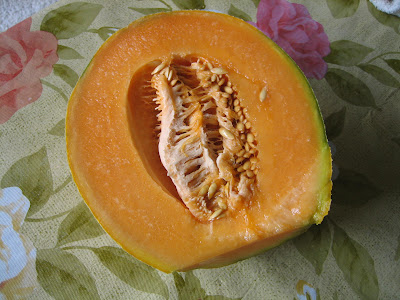
Cucumis melo is a species in the family Cucurbitaceae, which includes nearly all melons and squashes. Cantaloupes range in size from 0.5 kg to 5.0 kg. Cantaloupe has come to mean any orange-fleshed melon.


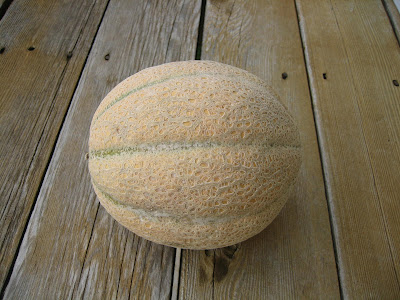
The North American cantaloupe is Cucumis melo reticulatus, a different member of the same muskmelon species. It is named reticulatus because of its net-like (or reticulated) skin covering. It is a round melon with firm, orange, moderately sweet flesh and a thin reticulated light-brown rind.


The cantaloupe originated in India and Africa. Cantaloupes were originally cultivated by the Egyptians and later the Greeks and Romans.

Cantaloupes were first introduced to North America by Christopher Columbus on his second voyage to the New World in 1494. The W. Atlee Burpee Company developed and introduced the "Netted Gem" in 1881 from varieties then growing in North America.

Because they are descended from tropical plants, and tend to require warm temperatures throughout a relatively long growing period, cantaloupes grown in temperate climates are frequently started indoors, and grown indoors for 14 days or longer, before being transplanted outdoors.

Cantaloupe are often picked, and shipped, before fully ripening. Post-harvest practices include treatment with a sodium hypochlorite wash to prevent mold growth and salmonella growth. However this treatment can mask the melon's musky aroma.

Because the surface of a cantaloupe can contain harmful bacteria—in particular, salmonella —it is always a good idea to wash a melon thoroughly before cutting and consumption. Only store the fruit after cutting for less than three days to prevent risk of salmonella or other bacterial pathogens.

A moldy cantaloupe in a Peoria, Illinois market in 1941 was found to contain the best and highest quality penicillin after a worldwide search.

References:
http://en.wikipedia.org/wiki/Cantaloupe

Forelle Pear

Forelle pear is cultivar of the European pear. A cultivar is a cultivated variety of a plant that has been deliberately selected for specific desirable characteristics (such as the colour and form of the flower, yield of the crop, disease resistance etc.).

The European Pear (Pyrus communis) is a species of pear native to central and eastern Europe and southwest Asia. The European Pear is one of the most important fruits of temperate regions, being the species from which most orchard pear cultivars grown in Europe, North America and Australia are developed.

IMAG0196.jpg

IMAG0200.jpg

European pear trees are not quite as hardy as apples, but nearly so. For best and most consistent quality, European Pears are picked when the fruit matures, but before they are ripe. Fruit allowed to ripen on the tree often drops before it can be picked and in any event will be hard to pick without bruising.

Fermented pear juice is called perry.

There are relatively few cultivars of European or Asian pear grown worldwide. Only about 20-25 European and 10-20 Asian cultivars represent virtually all the pears of commerce. Almost all European cultivars were chance seedlings or selections originating in western Europe, mostly France.

'Bartlett' is the most common pear cultivar in the world, and represents about 75% of US pear production.

References:
European Pear. Wikipedia.

Bartlett (Williams) Pear

There are over 3,000 known pear varieties grown around the world.

When you say "pear" most people picture a yellow Bartlett. The Williams' Bon Chrétien pear is commonly called Williams pear in Europe and Bartlett pear in the U.S. It is the most commonly grown variety of pear in most countries outside Asia.

The Bartlett pear is a cultivar of the European pear. A cultivar is a cultivated plant that has been selected and given a unique name because of desired characteristics.

The European Pear (Pyrus communis) is a species of pear native to central and eastern Europe and southwest Asia. The European Pear is one of the most important fruits of temperate regions, it is the species from which most pear cultivars grown in Europe, North America and Australia are developed.

Major pear cultivars

In the United States, 95% of pear production came from 4 cultivars:


- 50% Williams' Bon Chrétien (England, ca. 1770; a summer pear commonly called Bartlett in the U.S. and Canada, and Williams elsewhere)
- 34% Beurre d'Anjou (France, a winter pear commonly called just d'Anjou)
- 10% Beurre Bosc (Also known as Kaiser Alexander, a winter pear commonly called just Bosc or Kaiser)
- 1% Doyenné du Comice (France, 1849; commonly called Comice pears)


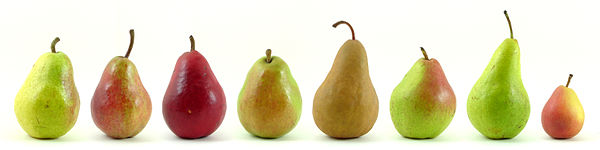
8 varieties of pears, from left to right, Williams' Bon Chrétien (sold in the U.S. as Bartlett), 2 Red Bartlett varieties, d'Anjou, Bosc, Comice, Concorde, and Seckel. Image source: Wikipedia, Agyle, public domain.

In 1985s, the Bartlett pear represented 80% of U.S. pear production, which decreased to 50% in 2004, displaced by the d'Anjou and Bosc pears, both winter pears more tolerant of cold than the Bartlett.

Bartlett (Williams) Pear

The fruit has a bell shape which is considered the traditional pear shape in the west. The green skin turns yellow upon later ripening. However, a red-skinned variety of Bartlett pear exists.

It is considered a summer pear, not as tolerant of cold as d'Anjou and Bosc pear.

History of Bartlett pear

The pear is thought to date from 1760s from the yard of an Aldermaston, England schoolmaster named Mr. Stair, giving rise to the now-obscure synonyms Aldermaston pear and Stairs pear. A nurseryman named Williams later acquired the variety, and after introducing it to the rest of England, the pear became known as the Williams Pear. The pear's full name is Williams' Bon Chretien, or "Williams' good Christian." 


In 1799 several Williams trees were imported in the United States and planted on the grounds of a Massachusetts acquired by Enoch Bartlett. Unaware of the trees origin, Bartlett named the pears after himself and introduced the variety into the United States. 

It was not realized that Bartlett and Williams Pears were the same until 1828. There are 150 synonyms for the pear worldwide.

Physical description of Bartlett pear

The Bartlett pear exhibits the typical pyriform, "pear shape". They are aromatic pears considered to have the definitive "pear flavor".  Pear trees are in production for 50-75 years.


Canned or baked pear

Bartlett pear holds its shape well when baked. It is also the primary choice for canned halves, juice and nectar in the U.S.


When to pick Bartlett pear

The Bartlett pear is best when picked with the internal pressure of the pear is between 18 psi and 16 psi. 


References:
Williams pear. Wikipedia.
European Pear. Wikipedia.
Yellow Bartlett. Pear Bureau Northwest.

Related:

Bosc Pear

There are over 3,000 known pear varieties grown around the world.

The Beurré Bosc or Bosc is a cultivar of the European Pear grown in the northwestern U.S. states, Australia, British Columbia and Europe, where it is sometimes called Kaiser.

A cultivar is a cultivated plant that has been selected and given a unique name because of desired characteristics.

The European Pear (Pyrus communis) is a species of pear native to central and eastern Europe and southwest Asia. The European Pear is one of the most important fruits of temperate regions, it is the species from which most pear cultivars grown in Europe, North America and Australia are developed.

Major pear cultivars

In the United States, 95% of pear production came from 4 cultivars:


- 50% Williams' Bon Chrétien (England, ca. 1770; a summer pear commonly called Bartlett in the U.S. and Canada, and Williams elsewhere)
- 34% Beurre d'Anjou (France, a winter pear commonly called just d'Anjou)
- 10% Beurre Bosc (Also known as Kaiser Alexander, a winter pear commonly called just Bosc or Kaiser)
- 1% Doyenné du Comice (France, 1849; commonly called Comice pears)

8 varieties of pears, from left to right, Williams' Bon Chrétien (sold in the U.S. as Bartlett), 2 Red Bartlett varieties, d'Anjou, Bosc, Comice, Concorde, and Seckel. Image source: Wikipedia, Agyle, public domain.

In 1985s, the Bartlett pear represented 80% of U.S. pear production, which decreased to 50% in 2004, displaced by the d'Anjou and Bosc pears, both winter pears more tolerant of cold than the Bartlett.

Characteristic features of the Bosc pear are a long tapering neck and russeted skin. Its flesh is denser and crisper than that of the Bartlett (Williams) or D'Anjou pear. It is called the "aristocrat of pears".

References:
Bosc Pear. Wikipedia.
European Pear. Wikipedia.

Related:

D'Anjou Pear (Anjou)

There are over 3,000 known pear varieties grown around the world.

The D'Anjou pear, sometimes referred to as the Beurré d'Anjou or simply Anjou, is a short-necked cultivar of European Pear.

A cultivar is a cultivated plant that has been selected and given a unique name because of desired characteristics.

The European Pear (Pyrus communis) is a species of pear native to central and eastern Europe and southwest Asia. The European Pear is one of the most important fruits of temperate regions, it is the species from which most pear cultivars grown in Europe, North America and Australia are developed.

Major pear cultivars

In the United States, 95% of pear production came from 4 cultivars:

- 50% Williams' Bon Chrétien (England, ca. 1770; a summer pear commonly called Bartlett in the U.S. and Canada, and Williams elsewhere)
- 34% Beurre d'Anjou (France, a winter pear commonly called just d'Anjou)
- 10% Beurre Bosc (Also known as Kaiser Alexander, a winter pear commonly called just Bosc or Kaiser)
- 1% Doyenné du Comice (France, 1849; commonly called Comice pears)


8 varieties of pears, from left to right, Williams' Bon Chrétien (sold in the U.S. as Bartlett), 2 Red Bartlett varieties, d'Anjou, Bosc, Comice, Concorde, and Seckel. Image source: Wikipedia, Agyle, public domain.

In 1985s, the Bartlett pear represented 80% of U.S. pear production, which decreased to 50% in 2004, displaced by the d'Anjou and Bosc pears, both winter pears more tolerant of cold than the Bartlett.

History of D'Anjou pear

D'Anjou pear is thought to have originated in the 19th century, either in Belgium or in the vicinity of Angers in central France, previously called the Anjou province.


Anjou is a former county and province centred on the city of Angers in the lower Loire Valley of western France. Image source: Wikipedia, Creative Commons Attribution ShareAlike 3.0 License.

Anjou pears are thought to have originated in Belgium but are named after the Anjou region in France. They were introduced to England in the 19th century. Called Beurré d' Anjou, they were introduced to America in 1842. The name has been shortened simply to "Anjou."

Characteristics of Anjou pear

There are two main varieties of D'Anjou pear:

- Green Anjou - pale green skin that may or may not change color to yellow as the pear ripens.

- Red Anjou - deep red skin. The first red sport of Anjou was discovered in the 1950's in Oregon.

The d'Anjou is considered a medium to large pear. It has a wide base, short stem, and thin skin with many notable lenticels, or pores, which allow the exchange of gases with the atmosphere. Green Anjou pears are recognizable for their egg-shaped appearance.

In Season: September - July. The flesh is described as "creamy white, aromatic, juicy, sweet, slightly acidic, with buttery and slightly gritty texture."

Anjou pears do not change color as they ripen, unlike Bartlett, another green pear variety whose skin color changes to yellow. Green Anjous will remain green even when fully ripe.

Anjou pears are the second-most recognizable pear variety in the United States (after Bartlett pears). It is the most abundant variety, which means you'll find green Anjou pears on produce stands in the U.S. nearly year round. Many chefs choose the Anjou pear for their menus for their nearly year-round availability.

D'Anjou pears are often less expensive than other pear varieties. In the United States, the variety represents 34% of pear production.

References:
D'Anjou. Wikipedia.
European Pear. Wikipedia.
Anjou Pears. Pear Bureau Northwest.
Red Anjou Pears. Pear Bureau Northwest.
Blog Widget by LinkWithin