Showing posts with label Flowers. Show all posts
Showing posts with label Flowers. Show all posts
The hidden beauty of pollination - TED Talks video
Pollination: it's vital to life on Earth, but largely unseen by the human eye. Filmmaker shows us the intricate world of pollen and pollinators with gorgeous high-speed images from the film "Wings of Life," inspired by the vanishing of one of nature's primary pollinators, the honeybee.


Colombia is the second-largest exporter of cut flowers, after the Netherlands
From the Smithsonian magazine:
A 1967 term paper by a graduate student in horticulture at Colorado State University titled “Bogotá, Colombia as a Cut-Flower Exporter for World Markets” started the boom in this Latin American country. The paper suggested that the savanna near Colombia’s capital was an ideal place to grow flowers to sell in the United States.
The savanna is a high plain fanning out from the Andean foothills, about 8,700 feet above sea level and 320 miles north of the Equator, and close to both the Pacific Ocean and the Caribbean Sea. Those circumstances create a pleasant climate with little temperature variation and consistent light, about 12 hours per day year-round. A former lakebed, the savanna also has dense, clay-rich soil and networks of wetlands, tributaries and waterfalls left after the lake receded 100,000 years ago. And Bogotá is just a three-hour flight from Miami—closer to East Coast customers than California, the center of the U.S. flower industry.
Producing a single rose bloom requires as much as three gallons of water.
View Larger Map
Today, the country is the world’s second-largest exporter of cut flowers, after the Netherlands, shipping more than $1 billion in blooms. Colombia now commands about 70 percent of the U.S. market; if you buy a bouquet in a supermarket, big-box store or airport kiosk, it probably came from the Bogotá savanna.
The country is the world’s second-largest exporter of cut flowers, after the Netherlands.
The global marketplace will always demand cheaper flowers, and Colombian farms must compete with growers in other nations, including neighboring Ecuador and rising flower power Kenya.
References:
The Secrets Behind Your Flowers. Smithsonian magazine, February 2011.
A 1967 term paper by a graduate student in horticulture at Colorado State University titled “Bogotá, Colombia as a Cut-Flower Exporter for World Markets” started the boom in this Latin American country. The paper suggested that the savanna near Colombia’s capital was an ideal place to grow flowers to sell in the United States.
The savanna is a high plain fanning out from the Andean foothills, about 8,700 feet above sea level and 320 miles north of the Equator, and close to both the Pacific Ocean and the Caribbean Sea. Those circumstances create a pleasant climate with little temperature variation and consistent light, about 12 hours per day year-round. A former lakebed, the savanna also has dense, clay-rich soil and networks of wetlands, tributaries and waterfalls left after the lake receded 100,000 years ago. And Bogotá is just a three-hour flight from Miami—closer to East Coast customers than California, the center of the U.S. flower industry.
Producing a single rose bloom requires as much as three gallons of water.
View Larger Map
Today, the country is the world’s second-largest exporter of cut flowers, after the Netherlands, shipping more than $1 billion in blooms. Colombia now commands about 70 percent of the U.S. market; if you buy a bouquet in a supermarket, big-box store or airport kiosk, it probably came from the Bogotá savanna.
The country is the world’s second-largest exporter of cut flowers, after the Netherlands.
The global marketplace will always demand cheaper flowers, and Colombian farms must compete with growers in other nations, including neighboring Ecuador and rising flower power Kenya.
References:
The Secrets Behind Your Flowers. Smithsonian magazine, February 2011.
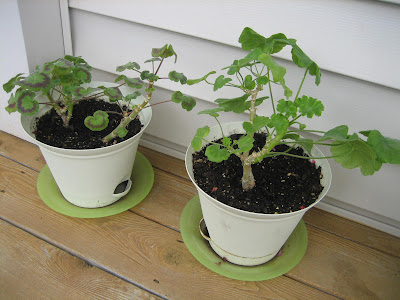
Pelargonium (geranium)
From Wikipedia:
Pelargonium is a genus of flowering plants which includes about 200 species of perennials, succulents, and shrubs, commonly known as geraniums or storksbills. Confusingly, Geranium is the correct botanical name of a separate genus of related plants often called Cranesbills. Gardeners sometimes refer to the members of Genus Pelargonium as "pelargoniums" in order to avoid the confusion, but the older common name "geranium" is still in regular use.
The first species of Pelargonium known to be cultivated was Pelargonium triste, a native of South Africa. It was probably brought to the botanical garden in Leiden before 1600 on ships which stopped at the Cape of Good Hope. In 1631, the English gardener, John Tradescant the elder, bought seeds from Rene Morin in Paris and introduced the plant to England. The name Pelargonium was introduced by Johannes Burman in 1738, from the Greek πελαργός, pelargós, stork, because part of the flower looks like a stork's beak.
Other than grown for their beauty, species of Pelargonium such as P. graveolens are important in the perfume industry and are cultivated and distilled for its scent. The varieties with rose scents are most commercially important.
Pelargoniums are believed to deter mosquitoes.
Garden geranium (Pelargonium x hortorum; syn. Pelargonium zonale) is one of the most common ornamental potted-plants, with over 200 varieties.
Species of Pelargonium are indigenous to Southern Africa and are drought and heat tolerant, and can tolerate only minor frosts. Pelargoniums are extremely popular garden plants, grown as annuals in temperate climates, and thousands of ornamental cultivars have been developed from about 20 of the species.
References:
Pelargonium. Wikipedia.
Subscribe to:
Posts (Atom)
