Samuel (also Samuil, representing Bulgarian Самуил, pronounced [samuˈil]) was the Tsar (Emperor) of the First Bulgarian Empire from 997 to 6 October 1014. From 977 to 997, he was a general under Roman I of Bulgaria, the second surviving son of Emperor Peter I of Bulgaria, and co-ruled with him, as Roman bestowed upon him the command of the army and the effective royal authority.
As Samuel struggled to preserve his country's independence from the Byzantine Empire, his rule was characterized by constant warfare against the Byzantines and their ambitious ruler Basil II.
In his early years Samuel managed to inflict several major defeats on the Byzantines and to launch offensive campaigns into their territory. But from 1001, he was forced mainly to defend the Empire against the Byzantine armies.
Samuel died of a heart attack on 6 October 1014, two months after the catastrophic battle of Kleidion, and Bulgaria was fully subjugated by Basil II four years later, ending the five decades-long Byzantine–Bulgarian conflict.
Samuel was considered "invincible in power and unsurpassable in strength". Similar comments were made even in Constantinople, where John Kyriotes penned a poem offering a punning comparison between the Bulgarian Emperor and a comet which appeared in 989.
During Samuel's reign, Bulgaria gained control of most of the Balkans (with the notable exception of Thrace) as far as southern Greece. He moved the capital from Skopje to Ohrid, which had been the cultural and military center of southwestern Bulgaria since Boris I's rule, and made the city the seat of the Bulgarian Patriarchate.
Although Samuel's reign brought the end of the First Bulgarian Empire, he is regarded as a heroic ruler in Bulgaria.
References:
http://en.wikipedia.org/wiki/Samuel_of_Bulgaria
Related:
Очите на паметника на цар Самуил светнаха (снимки), 24chasa, 2015 http://buff.ly/1efkr7Z
Showing posts with label Bulgarian Kings. Show all posts
Showing posts with label Bulgarian Kings. Show all posts

Bulgarian Kings: Presian (Bulgarian: Пресиян)
From Wikipedia:
Presian (Bulgarian: Пресиян, Персиян) was the ruler of Bulgaria in 836–852. The Byzantine sources indicate that Presian I was the son of Zvinica (Zbēnitzēs), who was a son of Omurtag.
Presian may have been young and inexperienced at the time of his accession, and state affairs may have been dominated by the minister (kaukhanos) Isbul, as under Presian's uncle Malamir.
Soon after Presian's accession, the Slavs in the vicinity of Thessalonica rebelled against the Byzantine Empire in 837. Emperor Theophilos sought Bulgarian support in putting down the rebellion, but simultaneously arranged for his fleet to sail through the Danube delta and undertake a clandestine evacuation of some of the Byzantine captives settled in trans-Danubian Bulgaria by Krum and Omurtag.
In retaliation Isbul campaigned along the Aegean coasts of Thrace and Macedonia and captured the city of Philippi, where he set up a surviving memorial inscription set up in a local church.
Presian's reign apparently coincides with the extension of Bulgarian control over the Slavic tribes in and around Macedonia. However, Presian's campaigns against the Serbs in about 839–842 failed. By the end of Presian's reign Serbia and Bulgaria lived in an uneasy peace.
References:
Presian. Wikipedia.
http://en.wikipedia.org/wiki/Presian
Presian (Bulgarian: Пресиян, Персиян) was the ruler of Bulgaria in 836–852. The Byzantine sources indicate that Presian I was the son of Zvinica (Zbēnitzēs), who was a son of Omurtag.
Presian may have been young and inexperienced at the time of his accession, and state affairs may have been dominated by the minister (kaukhanos) Isbul, as under Presian's uncle Malamir.
Soon after Presian's accession, the Slavs in the vicinity of Thessalonica rebelled against the Byzantine Empire in 837. Emperor Theophilos sought Bulgarian support in putting down the rebellion, but simultaneously arranged for his fleet to sail through the Danube delta and undertake a clandestine evacuation of some of the Byzantine captives settled in trans-Danubian Bulgaria by Krum and Omurtag.
In retaliation Isbul campaigned along the Aegean coasts of Thrace and Macedonia and captured the city of Philippi, where he set up a surviving memorial inscription set up in a local church.
Presian's reign apparently coincides with the extension of Bulgarian control over the Slavic tribes in and around Macedonia. However, Presian's campaigns against the Serbs in about 839–842 failed. By the end of Presian's reign Serbia and Bulgaria lived in an uneasy peace.
References:
Presian. Wikipedia.
http://en.wikipedia.org/wiki/Presian
Bulgarian Kings: Malamir (Bulgarian: Маламир)
From Wikipedia:
Malamir was a son of Omurtag and a grandson of Krum. His name is said to be of Slavic origin, and is claimed to be the first Bulgar khan to possess a Slavic name. This has led to the speculation that his mother was a Slav, which cannot be proven.
Malamir became ruler of Bulgaria in 831 on the death of his father Omurtag, because his older brother Enravota (Voin) had forfeited his right to the succession by becoming a Christian. It is possible that Malamir was young and inexperienced at the time of his accession, and that affairs of state were managed by his minister (kaukhanos) Isbul.
Around 833, Malamir executed his older brother Enravota for refusing to renounce Christianity. After the expiration of the original 20-year peace treaty with the Byzantine Empire in 836, emperor Theophilos ravaged the regions inside the Bulgarian frontier.
The Bulgarians retaliated, and under the leadership of Isbul they reached Adrianople. At this time, if not earlier, the Bulgarians annexed Philippopolis (Plovdiv) and its environs.
Malamir died in 836, allegedly as retribution for his execution of his older brother.
References:
Malamir. Wikipedia.
http://en.wikipedia.org/wiki/Malamir_of_Bulgaria
Malamir was a son of Omurtag and a grandson of Krum. His name is said to be of Slavic origin, and is claimed to be the first Bulgar khan to possess a Slavic name. This has led to the speculation that his mother was a Slav, which cannot be proven.
Malamir became ruler of Bulgaria in 831 on the death of his father Omurtag, because his older brother Enravota (Voin) had forfeited his right to the succession by becoming a Christian. It is possible that Malamir was young and inexperienced at the time of his accession, and that affairs of state were managed by his minister (kaukhanos) Isbul.
Around 833, Malamir executed his older brother Enravota for refusing to renounce Christianity. After the expiration of the original 20-year peace treaty with the Byzantine Empire in 836, emperor Theophilos ravaged the regions inside the Bulgarian frontier.
The Bulgarians retaliated, and under the leadership of Isbul they reached Adrianople. At this time, if not earlier, the Bulgarians annexed Philippopolis (Plovdiv) and its environs.
Malamir died in 836, allegedly as retribution for his execution of his older brother.
References:
Malamir. Wikipedia.
http://en.wikipedia.org/wiki/Malamir_of_Bulgaria
Bulgarian Kings: Omurtag (Bulgarian: Омуртаг)
From Wikipedia:
Omurtag or Omortag (Bulgarian: Омуртаг) was a Great Khan (Kana syubigi) of Bulgaria from 815 to 831. He is known as "the Builder".
In the very beginning of his reign he signed a 30-year peace treaty with the Byzantines which remained in force to the end of his life. Omurtag successfully coped with the aggressive policy of the Frankish Empire to take Bulgaria's north-western lands and suppressed the unrest among several Slavic tribes. He made administrative reforms which increased the power and the authority of the central government. His reign was marked with a strong development of the Bulgarian architecture with a number of significant construction projects.
Omurtag's Tarnovo Inscription
The Omurtag's Tarnovo Inscription is an inscription in Greek language, engraved on a column of dark syenite found in the SS. Forty Martyrs Church in Tarnovo. The inscription was known since 1858 when Hristo Daskalov from Tryavna managed to visit the church (which was converted to a mosque at that time) and to make a replica of the inscription.
Along with the Chatalar Inscription, the Tarnovo inscription testifies for the active construction during the reign of Khan Omurtag (814-831). It is assumed that the inscription was made in 822. The historians are uncertain about the original location of the inscription (probably Pliska) and the location of the "new home on the Danube", for which the inscription was created - Silistra, the village of Malak Preslavets.
The final lines of Omurtag's Turnovo Inscription reveal Omurtag's message to future generations:
"Even if a man lives well, he dies and another one comes into existence. Let the one who comes later upon seeing this inscription remember the one who had made it."
Persecution of the Christians
Omurtag pursued policy of repression against Christians, in particular against the Byzantine prisoners of war settled by his father Krum in Bulgaria (mostly north of the Danube). This policy may have been motivated in part by the Byzantine invasion of 811 or with the beginning of Christian proselytizing by members of the substantial captive population. In connection with these policies, Omurtag disinherited his eldest son Enravota (Voin or Boyan), who had shown himself sympathetic to Christianity.
References:
Omurtag. Wikipedia.
http://en.wikipedia.org/wiki/Omurtag_of_Bulgaria
Omurtag's Tarnovo Inscription
http://en.wikipedia.org/wiki/Omurtag's_Tarnovo_Inscription
Omurtag or Omortag (Bulgarian: Омуртаг) was a Great Khan (Kana syubigi) of Bulgaria from 815 to 831. He is known as "the Builder".
In the very beginning of his reign he signed a 30-year peace treaty with the Byzantines which remained in force to the end of his life. Omurtag successfully coped with the aggressive policy of the Frankish Empire to take Bulgaria's north-western lands and suppressed the unrest among several Slavic tribes. He made administrative reforms which increased the power and the authority of the central government. His reign was marked with a strong development of the Bulgarian architecture with a number of significant construction projects.
Omurtag's Tarnovo Inscription
The Omurtag's Tarnovo Inscription is an inscription in Greek language, engraved on a column of dark syenite found in the SS. Forty Martyrs Church in Tarnovo. The inscription was known since 1858 when Hristo Daskalov from Tryavna managed to visit the church (which was converted to a mosque at that time) and to make a replica of the inscription.
Along with the Chatalar Inscription, the Tarnovo inscription testifies for the active construction during the reign of Khan Omurtag (814-831). It is assumed that the inscription was made in 822. The historians are uncertain about the original location of the inscription (probably Pliska) and the location of the "new home on the Danube", for which the inscription was created - Silistra, the village of Malak Preslavets.
The final lines of Omurtag's Turnovo Inscription reveal Omurtag's message to future generations:
"Even if a man lives well, he dies and another one comes into existence. Let the one who comes later upon seeing this inscription remember the one who had made it."
Persecution of the Christians
Omurtag pursued policy of repression against Christians, in particular against the Byzantine prisoners of war settled by his father Krum in Bulgaria (mostly north of the Danube). This policy may have been motivated in part by the Byzantine invasion of 811 or with the beginning of Christian proselytizing by members of the substantial captive population. In connection with these policies, Omurtag disinherited his eldest son Enravota (Voin or Boyan), who had shown himself sympathetic to Christianity.
References:
Omurtag. Wikipedia.
http://en.wikipedia.org/wiki/Omurtag_of_Bulgaria
Omurtag's Tarnovo Inscription
http://en.wikipedia.org/wiki/Omurtag's_Tarnovo_Inscription
Bulgarian Kings: Krum (Bulgarian: Крум)
From Wikipedia:
Krum (Bulgarian: Крум) was Khan of Bulgaria, from after 796 to 814 AD. During his reign the Bulgarian territory doubled in size, spreading from the middle Danube to the Dnieper and from Odrin to the Tatra Mountains.
Family Origin
There are two hypotheses about the family origin of Krum. According to the first one, his family has come from Pannonia, where it had been in service of the Avars whereas according the second and more popular, Krum was born in Macedonia. This could give further explanation to the fact that Krum was described and portrayed by the Byzantine chronists as a light-hairеd man with light eyes.
Establishment of New Borders
In c. 805, Krum took advantage of the defeat of the Avar Khaganate to destroy the remainder of the Avars and to expand his authority across the Carpathians over Transylvania and along the Danube into eastern Pannonia. This resulted in the establishment of a common border between the Frankish Empire and Bulgaria, which would have important repercussions for the policy of Krum's successors.
5 интересни факта за хан Крум - YouTube https://www.youtube.com/watch?v=XbAMIV1xjfY
Conflict with Nikephoros I
Krum engaged in a policy of territorial expansion. In 807 the Bulgarian forces defeated the Byzantine army in the Struma valley. In 809 Krum besieged and forced the surrender of Serdica (Sofia), slaughtering the Byzantine garrison of 6,000 men in spite of his promise of safe conduct (Siege of Serdica, 809). This provoked the reaction of the Byzantine Emperor Nikephoros I, who proceeded to settle Anatolian populations along the frontier to protect it. He also attempted to retake and refortify Serdica, although this enterprise ultimately failed.
In early 811, Nikephoros I undertook a massive expedition against Bulgaria, and advanced to Marcellae (near Karnobat). Here Krum attempted to negotiate on July 11, 811, but Nikephoros was determined to continue with his advance. His army managed to avoid the Bulgarian ambushes in the Balkan Mountains and defeated an army of 12,000 men that tried to block their advance into Moesia. Another hastily assembled army of 50,000 men was defeated before the walls of the Bulgarian capital Pliska, which fell to the emperor on July 20. Here Nikephoros, who had been a financial minister before becoming emperor, helped himself to the treasures of Krum, while setting the city afire and turning his army on the population. A new diplomatic tentative from Krum was rebuffed.
While Nikephoros I and his army were busy pillaging, devastating and plundering the Bulgarian capital, Krum mobilized his people (including the women) to set traps and ambushes in the mountain passes. On his way back to Constantinople the emperor learnt about these preparations for battle. The panicked emperor repeatedly stated to his companions "Even if we have had wings we could not have escaped from peril." At dawn on July 26 the Byzantines found themselves trapped against a moat and wooden wall in the Vărbica pass. Nikephoros was killed in the ensuing battle together with many of his troops, while his son Staurakios was carried to safety by the imperial bodyguard after receiving a paralyzing wound to his neck. According to tradition, Krum had the Emperor's skull lined with silver and used it as a drinking cup.
Krum spent the winter of 813 preparing for a major attack on Constantinople, where rumor reported the assembling of an extensive siege park to be transported on 5,000 carts. However, before he set out, he died on April 13, 814, and was succeeded by his son Omurtag.
Legacy
Krum was also remembered for instituting the first known written Bulgarian law code which ensured subsidies to beggars and state protection to all poor Bulgarians. Drinking, slander and robbery were severely punished. Through his laws he became known as a strict but just ruler, bringing Slavs and Bulgars into a centralized state.
References:
Krum. Wikipedia.
Related reading:
Загадъчната смърт на кханасюбиги Крум - SegaBG, 2014 http://buff.ly/1cXbR4W
Krum (Bulgarian: Крум) was Khan of Bulgaria, from after 796 to 814 AD. During his reign the Bulgarian territory doubled in size, spreading from the middle Danube to the Dnieper and from Odrin to the Tatra Mountains.
Family Origin
There are two hypotheses about the family origin of Krum. According to the first one, his family has come from Pannonia, where it had been in service of the Avars whereas according the second and more popular, Krum was born in Macedonia. This could give further explanation to the fact that Krum was described and portrayed by the Byzantine chronists as a light-hairеd man with light eyes.
Establishment of New Borders
In c. 805, Krum took advantage of the defeat of the Avar Khaganate to destroy the remainder of the Avars and to expand his authority across the Carpathians over Transylvania and along the Danube into eastern Pannonia. This resulted in the establishment of a common border between the Frankish Empire and Bulgaria, which would have important repercussions for the policy of Krum's successors.
5 интересни факта за хан Крум - YouTube https://www.youtube.com/watch?v=XbAMIV1xjfY
Conflict with Nikephoros I
Krum engaged in a policy of territorial expansion. In 807 the Bulgarian forces defeated the Byzantine army in the Struma valley. In 809 Krum besieged and forced the surrender of Serdica (Sofia), slaughtering the Byzantine garrison of 6,000 men in spite of his promise of safe conduct (Siege of Serdica, 809). This provoked the reaction of the Byzantine Emperor Nikephoros I, who proceeded to settle Anatolian populations along the frontier to protect it. He also attempted to retake and refortify Serdica, although this enterprise ultimately failed.
In early 811, Nikephoros I undertook a massive expedition against Bulgaria, and advanced to Marcellae (near Karnobat). Here Krum attempted to negotiate on July 11, 811, but Nikephoros was determined to continue with his advance. His army managed to avoid the Bulgarian ambushes in the Balkan Mountains and defeated an army of 12,000 men that tried to block their advance into Moesia. Another hastily assembled army of 50,000 men was defeated before the walls of the Bulgarian capital Pliska, which fell to the emperor on July 20. Here Nikephoros, who had been a financial minister before becoming emperor, helped himself to the treasures of Krum, while setting the city afire and turning his army on the population. A new diplomatic tentative from Krum was rebuffed.
While Nikephoros I and his army were busy pillaging, devastating and plundering the Bulgarian capital, Krum mobilized his people (including the women) to set traps and ambushes in the mountain passes. On his way back to Constantinople the emperor learnt about these preparations for battle. The panicked emperor repeatedly stated to his companions "Even if we have had wings we could not have escaped from peril." At dawn on July 26 the Byzantines found themselves trapped against a moat and wooden wall in the Vărbica pass. Nikephoros was killed in the ensuing battle together with many of his troops, while his son Staurakios was carried to safety by the imperial bodyguard after receiving a paralyzing wound to his neck. According to tradition, Krum had the Emperor's skull lined with silver and used it as a drinking cup.
Krum spent the winter of 813 preparing for a major attack on Constantinople, where rumor reported the assembling of an extensive siege park to be transported on 5,000 carts. However, before he set out, he died on April 13, 814, and was succeeded by his son Omurtag.
Legacy
Krum was also remembered for instituting the first known written Bulgarian law code which ensured subsidies to beggars and state protection to all poor Bulgarians. Drinking, slander and robbery were severely punished. Through his laws he became known as a strict but just ruler, bringing Slavs and Bulgars into a centralized state.
References:
Krum. Wikipedia.
Khan Krum in the mind of today's students during exams. Trud.bg, newspaper, in Bulgarian.
Related reading:
Загадъчната смърт на кханасюбиги Крум - SegaBG, 2014 http://buff.ly/1cXbR4W
Bulgarian Kings: Kardam (Bulgarian: Кардам)
From Wikipedia:
Kardam (Bulgarian: Кардам) was the ruler of Bulgaria 777–803.
The name of Kardam is first encountered in the Byzantine sources in 791, when Emperor Constantine VI embarked on an expedition against Bulgaria, in retaliation for Bulgarian incursions in the Struma valley since 789. Kardam pre-empted the Byzantine invasion and met the enemy near Adrianople in Thrace. The Byzantine army was defeated and turned to flight.
In 792 Constantine VI led another army against the Bulgarians and encamped at Marcellae (near Karnobat), which he proceeded to fortify. Kardam arrived with his army on July 20 and occupied the neighboring heights. After some time passed with the two forces sizing up, Constantine VI gave in to the reassuring advice of a "false prophet" and ordered the attack. But the Byzantine forces lost formation and once again were defeated and turned to flight, while Kardam captured the imperial tent and the emperor's servants (battle of Marcelae). After his return to Constantinople, Constantine VI signed a peace treaty and undertook to pay an annual tribute to Bulgaria.
By 796 the imperial government was recalcitrant and Kardam found it necessary to demand the tribute while threatening to devastate Thrace if it were not paid. According to the chronicler Theophanes the Confessor, Constantine VI mocked the demand by having dung sent instead of gold as "fitting tribute" and promising to lead a new army against the elderly Kardam at Marcellae.
Once again the emperor headed north, and once again he encountered Kardam in the vicinity of Adrianople. The armies faced each other for 17 days without entering into battle, while the two monarchs probably engaged in negotiations. In the end conflict was averted and the peace resumed on the same terms as in 792.
The reign of Kardam represents the restoration of order in Bulgaria, which had suffered from a rapid turnover of rulers and had been repeatedly defeated by the Byzantines in the third quarter of the 8th century. Kardam not only stood his ground against Constantine VI (who was trying to emulate his much more successful grandfather and namesake Constantine V), but he may have succeeded in precipitating a crisis at the Byzantine court, where Constantine VI's repeated failures undermined the emperor's position and he was dethroned by his mother Irene in 797. Kardam probably did not long survive his opponent, as he is not heard of after 796 and was already dead by 803.
References:
Kardam. Wikipedia.
http://en.wikipedia.org/wiki/Kardam_of_Bulgaria
Kardam (Bulgarian: Кардам) was the ruler of Bulgaria 777–803.
The name of Kardam is first encountered in the Byzantine sources in 791, when Emperor Constantine VI embarked on an expedition against Bulgaria, in retaliation for Bulgarian incursions in the Struma valley since 789. Kardam pre-empted the Byzantine invasion and met the enemy near Adrianople in Thrace. The Byzantine army was defeated and turned to flight.
In 792 Constantine VI led another army against the Bulgarians and encamped at Marcellae (near Karnobat), which he proceeded to fortify. Kardam arrived with his army on July 20 and occupied the neighboring heights. After some time passed with the two forces sizing up, Constantine VI gave in to the reassuring advice of a "false prophet" and ordered the attack. But the Byzantine forces lost formation and once again were defeated and turned to flight, while Kardam captured the imperial tent and the emperor's servants (battle of Marcelae). After his return to Constantinople, Constantine VI signed a peace treaty and undertook to pay an annual tribute to Bulgaria.
By 796 the imperial government was recalcitrant and Kardam found it necessary to demand the tribute while threatening to devastate Thrace if it were not paid. According to the chronicler Theophanes the Confessor, Constantine VI mocked the demand by having dung sent instead of gold as "fitting tribute" and promising to lead a new army against the elderly Kardam at Marcellae.
Once again the emperor headed north, and once again he encountered Kardam in the vicinity of Adrianople. The armies faced each other for 17 days without entering into battle, while the two monarchs probably engaged in negotiations. In the end conflict was averted and the peace resumed on the same terms as in 792.
The reign of Kardam represents the restoration of order in Bulgaria, which had suffered from a rapid turnover of rulers and had been repeatedly defeated by the Byzantines in the third quarter of the 8th century. Kardam not only stood his ground against Constantine VI (who was trying to emulate his much more successful grandfather and namesake Constantine V), but he may have succeeded in precipitating a crisis at the Byzantine court, where Constantine VI's repeated failures undermined the emperor's position and he was dethroned by his mother Irene in 797. Kardam probably did not long survive his opponent, as he is not heard of after 796 and was already dead by 803.
References:
Kardam. Wikipedia.
http://en.wikipedia.org/wiki/Kardam_of_Bulgaria
Bulgarian Kings: Kardam (Bulgarian: Кардам)
From Wikipedia:
Kardam (Bulgarian: Кардам) was the ruler of Bulgaria 777–803. The name of Kardam is first encountered in the Byzantine sources in 791, when Emperor Constantine VI embarked on an expedition against Bulgaria, in retaliation for Bulgarian incursions in the Struma valley since 789. Kardam pre-empted the Byzantine invasion and met the enemy near Adrianople in Thrace. The Byzantine army was defeated and turned to flight.
In 792 Constantine VI led another army against the Bulgarians and encamped at Marcellae (near Karnobat), which he proceeded to fortify. Kardam arrived with his army and occupied the neighboring heights. Constantine VI ordered an attack but the Byzantine forces lost formation and were defeated and turned to flight, while Kardam captured the imperial tent and the emperor's servants. After his return to Constantinople, Constantine VI signed a peace treaty and undertook to pay an annual tribute to Bulgaria.
By 796 the imperial government was recalcitrant and Kardam found it necessary to demand the tribute while threatening to devastate Thrace if it were not paid. Constantine VI mocked the demand by having dung sent instead of gold as "fitting tribute" and promising to lead a new army against the elderly Kardam. Once again the emperor headed north, and he encountered Kardam in the vicinity of Adrianople. The armies faced each other for 17 days without entering into battle, while the two monarchs probably engaged in negotiations. In the end, conflict was averted and the peace resumed on the same terms as in 792.
The reign of Kardam represents the restoration of order in Bulgaria, which had suffered from a rapid turnover of rulers and had been repeatedly defeated by the Byzantines in the third quarter of the 8th century. Kardam not only stood his ground against Constantine VI (who was trying to emulate his much more successful grandfather and namesake Constantine V), but he may have succeeded in precipitating a crisis at the Byzantine court, where Constantine VI's repeated failures undermined the emperor's position and he was dethroned by his mother Irene in 797. Kardam probably did not long survive his opponent, as he is not heard of after 796 and was already dead in 803.
His successor Korym (i.e., Krum) was probably his nephew. Kardam's accession signifies the final restoration of the Dulo clan, which would have retained the throne until the death of Roman in 997.
Video: The Bulgarian Rulers (for illustrative purposes only, the accuracy can be disputed).
References:
Kardam of Bulgaria. Wikipedia.
Kardam (Bulgarian: Кардам) was the ruler of Bulgaria 777–803. The name of Kardam is first encountered in the Byzantine sources in 791, when Emperor Constantine VI embarked on an expedition against Bulgaria, in retaliation for Bulgarian incursions in the Struma valley since 789. Kardam pre-empted the Byzantine invasion and met the enemy near Adrianople in Thrace. The Byzantine army was defeated and turned to flight.
In 792 Constantine VI led another army against the Bulgarians and encamped at Marcellae (near Karnobat), which he proceeded to fortify. Kardam arrived with his army and occupied the neighboring heights. Constantine VI ordered an attack but the Byzantine forces lost formation and were defeated and turned to flight, while Kardam captured the imperial tent and the emperor's servants. After his return to Constantinople, Constantine VI signed a peace treaty and undertook to pay an annual tribute to Bulgaria.
By 796 the imperial government was recalcitrant and Kardam found it necessary to demand the tribute while threatening to devastate Thrace if it were not paid. Constantine VI mocked the demand by having dung sent instead of gold as "fitting tribute" and promising to lead a new army against the elderly Kardam. Once again the emperor headed north, and he encountered Kardam in the vicinity of Adrianople. The armies faced each other for 17 days without entering into battle, while the two monarchs probably engaged in negotiations. In the end, conflict was averted and the peace resumed on the same terms as in 792.
The reign of Kardam represents the restoration of order in Bulgaria, which had suffered from a rapid turnover of rulers and had been repeatedly defeated by the Byzantines in the third quarter of the 8th century. Kardam not only stood his ground against Constantine VI (who was trying to emulate his much more successful grandfather and namesake Constantine V), but he may have succeeded in precipitating a crisis at the Byzantine court, where Constantine VI's repeated failures undermined the emperor's position and he was dethroned by his mother Irene in 797. Kardam probably did not long survive his opponent, as he is not heard of after 796 and was already dead in 803.
His successor Korym (i.e., Krum) was probably his nephew. Kardam's accession signifies the final restoration of the Dulo clan, which would have retained the throne until the death of Roman in 997.
Video: The Bulgarian Rulers (for illustrative purposes only, the accuracy can be disputed).
References:
Kardam of Bulgaria. Wikipedia.
Bulgarian Kings: Telerig (Bulgarian: Телериг)
From Wikipedia:
Telerig (Bulgarian: Телериг) was the ruler of Bulgaria 768–777. He was the immediate successor of Pagan, who was murdered in 768. In May 774, the Byzantine Emperor Constantine V Kopronymos embarked on a major expedition against Bulgaria, leading his field army on land, and dispatching a fleet of 2,000 ships carrying horsemen towards the Danube delta. The fleet dismebarked in the vicinity of Varna, but the emperor inexplicably retreated.
Shortly afterwards the two sides signed a truce promising the cessation of hostilities. However, in October 774 Telerig sent an army of 12,000 men to raid Berzitia, Macedonia and to transfer its population to Bulgaria. Collecting a large army of 80,000 troops, Constantine V surprised the Bulgarians and won a resounding victory. The subsequent attack on Bulgaria failed, because the imperial fleet encountered contrary winds in the Black Sea.
At this point Telerig sent a secret emissary to Constantine V, indicating his intention to flee Bulgaria and seek refuge with the emperor, and seeking assurances of hospitality. Telerig succeeded in having the emperor betray his own agents in Bulgaria, who were duly rounded up and executed. The expected Byzantine retaliation failed to materialize as Constantine V died in 775. In spite of his apparent success, Telerig found it necessary to flee to the new Byzantine emperor, Leo IV the Khazar in 777. The Byzantine government gave Telerig asylum and the title of patrikios. Telerig converted to Christianity under the name of Theophylaktos and married a cousin of the Empress Eirene.
References:
Telerig. Wikipedia.
Related books:
Telerig (Bulgarian: Телериг) was the ruler of Bulgaria 768–777. He was the immediate successor of Pagan, who was murdered in 768. In May 774, the Byzantine Emperor Constantine V Kopronymos embarked on a major expedition against Bulgaria, leading his field army on land, and dispatching a fleet of 2,000 ships carrying horsemen towards the Danube delta. The fleet dismebarked in the vicinity of Varna, but the emperor inexplicably retreated.
Shortly afterwards the two sides signed a truce promising the cessation of hostilities. However, in October 774 Telerig sent an army of 12,000 men to raid Berzitia, Macedonia and to transfer its population to Bulgaria. Collecting a large army of 80,000 troops, Constantine V surprised the Bulgarians and won a resounding victory. The subsequent attack on Bulgaria failed, because the imperial fleet encountered contrary winds in the Black Sea.
At this point Telerig sent a secret emissary to Constantine V, indicating his intention to flee Bulgaria and seek refuge with the emperor, and seeking assurances of hospitality. Telerig succeeded in having the emperor betray his own agents in Bulgaria, who were duly rounded up and executed. The expected Byzantine retaliation failed to materialize as Constantine V died in 775. In spite of his apparent success, Telerig found it necessary to flee to the new Byzantine emperor, Leo IV the Khazar in 777. The Byzantine government gave Telerig asylum and the title of patrikios. Telerig converted to Christianity under the name of Theophylaktos and married a cousin of the Empress Eirene.
References:
Telerig. Wikipedia.
Related books:
Bulgarian Kings: Tervel (Bulgarian: Тервел)
 From Wikipedia:
Tervel (Bulgarian: Тервел) was the ruler of the Bulgarians at the beginning of the 8th century. In 705 he received the title Caesar by the Byzantine emperor which was a precedent in history. He was probably a Christian like his grandfather Khan Kubrat. After the Bulgarian army crushed the Arabs during the siege of Constantinople (718) Tervel was called by contemporaries the Saviour of Europe.
The Nominalia of the Bulgarian khans states that Tervel belonged to the Dulo clan and reigned for 21 years (695–715). Tervel was likely the son and heir of his predecessor Asparukh, who had died in battle against the Khazars.
Alliance with Justinian II and becoming a Caesar
Tervel is first mentioned in the Byzantine sources in 704, when he was approached by the deposed and exiled Byzantine emperor Justinian II. Justinian acquired Tervel's support for an attempted restoration to the Byzantine throne in exchange for friendship, gifts, and his daughter in marriage. With an army of 15,000 horsemen provided by Tervel, Justinian suddenly advanced on Constantinople and managed to gain entrance into the city in 705.
The war with the Arabs in 717-718 or Siege of Constantinople (718), "Savior of Europe"
During the summer of 717 the Arabs led by Maslama crossed the Dardanelles and besieged Constantinople with 200,000 men. According to Arab sources, his fleet consisted of 2,500 ships.
Leo III plead to Tervel for help relying on the treaty of 716 and Tervel agreed. The first clash between the Bulgarians and the Arabs ended with a Bulgarian victory. During the very first stages of the siege the Bulgarians appeared in the Muslim rear and large part of their army was destroyed and the rest were trapped. The Arabs built two trenches around their camp facing the Bulgarian army and the walls of the city. They persisted with the siege despite the severe winter with 100 days of snowfall. In the summer of 718 the Arabs engaged the Bulgarians in a decisive battle but suffered a crushing defeat and had to abandon the siege. According to Theophanes, the Bulgarians slaughtered some 22,000 Arabs in the battle. The Bulgarian victory of 718 and the victory of the Frankish king Charles Martel in the battle of Tours stopped the Muslim invasion in the interior of Europe. Khan Tervel was called the Saviour of Europe by his contemporaries.
The Madara Rider monument
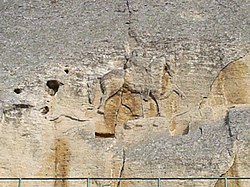
The basrelief of Madara Rider - a Bulgarian national symbol. Image source: Wikipedia, Svik, GNU Free Documentation License, Version 1.2.

During the time of Tervel, the famous rock relief the Madara Rider was created as a memorial to the Bulgar god Tangra, the victories over the Byzantines, to honour his father Asparukh and as an expression of the glory of the Bulgarian state.
Bulgarian rulers after Tervel (source: Wikipedia)
Ajjar (715) was the brother and successor of Tervel, and the uncle and predecessor of Kermes (Kormesiy).
Kormesiy (Bulgarian: Кормесий) was a ruler of Danubian Bulgaria who is sometimes considered the direct successor of Tervel. Kormesiy was a descendant of the royal Dulo clan and would have reigned 715–721 (or 738).
The name of Kormesiy is also found in the inscriptions around the Madara Rider monument. The surviving part of the text speaks of an annual gold tribute that Kormesiy received from the Byzantine Emperor - it seems as if the peace treaty was re-established during his rule. The end of the inscription mentions a worsening of Bulgarian relations with the Byzantine Empire. However, this inscription could possibly be referring to the later Bulgarian rulers Kormisoš or Krum.
Kormesiy (Kermes) was deposed by the nobility and replaced on the throne by his son Sevar.
Sevar (Bulgarian: Севар) belonged to the royal Dulo clan and ruled for 15 years (approx. 721–737 or 738–754). It is possible that his reign was peaceful, because the Byzantine chronicles do not report any events on the Empire’s northern borders from that period (same as with Kermes).
Kormisosh (Bulgarian: Кормисош) belonged to the Ukil (or Vokil) clan and ruled for 17 years (approx. 737–754 or 753–756). Kormisosh represents a change of dynasty, but it remains unclear whether that was done through violence. The reign of Kormisosh inaugurated a prolonged period of war with the Byzantine Empire. The Byzantine Emperor Constantine V Kopronymos had begun to fortify the frontier and started settling Armenians and Syrians in Byzantine Thrace. In response Kormisosh demanded the payment of tribute, perhaps constituting an increase in the traditional payments. Rebuffed, Kormisosh raided into Thrace, reaching the Anastasian Wall stretching between the Black Sea and the Sea of Marmara 40 km in front of Constantinople. Constantine V marched out with his army, defeated the Bulgarians and turned them to flight.
Kormisosh (Bulgarian: Кормисош) belonged to the Ukil (or Vokil) clan and ruled for 17 years (approx. 737–754 or 753–756). Kormisosh represents a change of dynasty, but it remains unclear whether that was done through violence. The reign of Kormisosh inaugurated a prolonged period of war with the Byzantine Empire. The Byzantine Emperor Constantine V Kopronymos had begun to fortify the frontier and started settling Armenians and Syrians in Byzantine Thrace. In response Kormisosh demanded the payment of tribute, perhaps constituting an increase in the traditional payments. Rebuffed, Kormisosh raided into Thrace, reaching the Anastasian Wall stretching between the Black Sea and the Sea of Marmara 40 km in front of Constantinople. Constantine V marched out with his army, defeated the Bulgarians and turned them to flight.
Vinekh (also spelled Vineh; Bulgarian: Винех) reigned for 7 years and was a member of the Ukil clan (approx. 754–762 or 756–762).
Vinekh ascended the throne after the defeat of his predecessor Kormisosh by the Eastern Roman Emperor Constantine V Kopronymos, which has led some scholars to assume that he was an usurper. In c. 756 Constantine V campaigned against Bulgaria by land and sea, and defeated the Bulgarian army led by Vinekh at Karnobat. The defeated monarch senr his own children as hostages. In 759 Constantine V invaded Bulgaria again, but this time his army was ambushed in the mountain passes of the Stara Planina (battle of the Rishki Pass). Vinekh did not follow up his victory and sought to re-establish the peace. This won him the opposition of the Bulgarian nobility, which had him massacred together with his family.
Telets (Bulgarian: Телец) reigned for 3 years (762–765) and was a member of the Ugain clan. Byzantine sources indicate that Telets replaced the legitimate rulers of Bulgaria and was a brave and energetic man in his prime (about 30 years old). Telets may have belonged to an anti-Slavic faction of the Bulgarian nobility.
After his accession, Telets led a well-trained and well-armed army against the Byzantine Empire and devastated the Empire's frontier zone, inviting the emperor to a contest of strength. Emperor Constantine V Kopronymos marched north in 763, while another army was carried by a fleet of 800 ships.
Telets at first fortified the mountain passes with his troops and some twenty thousand Slavic auxiliaries. Later he changes his mind and led out his troops to the plain of Anchialos (Pomorie). The bloody battle began at mid-morning, and lasted until dusk. At the end Telets was abandoned by his Slavic auxiliaries, who deserted to the emperor, who won the field, but chose to return home in triumph. According to the Byzantine sources, Constantine V brought home a throng of Bulgarian prisoners in wooden restraints, for the entertainment of Constantinople's populace.
The military defeat sealed the fate of Telets, who was lynched together with his supporters by his rebellious subjects.
Sabin (Bulgarian: Сабин) was the ruler of Bulgaria 765–766. He was a Slav related by marriage to Kormisosh, who was either a father-in-law or a brother-in-law of Sabin.
Sabin rose to the throne after the murder of Telets in 765 and represented that part of the Bulgarian nobility, which was seeking a policy of accommodation with the Byzantine Empire. He swiftly dispatched secret emissaries to Emperor Constantine V Kopronymos, who had recently defeated Sabin's predecessor Telets, seeking to re-establish peace. When the negotiations were discovered, the Bulgarians rebelled and held an assembly, in which they accused Sabin of causing Bulgaria's enslavement by the Byzantines.
Deserted by his supporters, Sabin fled to Byzantine Mesembria (Nesebăr) in 766, from where he went to Constantinople. There he was received by the emperor, who arranged for the transfer of Sabin's family from Bulgaria. In 768 Sabin attended Constantine V's negotiations with a new Bulgarian ruler, Pagan, but the emperor's words on behalf of the former monarch made little impression. Sabin passed the remainder of his life in exile.
Umor (Bulgarian: Умор) reigned for only 40 days in 766 and belonged to the Ukil clan, which makes him a relative of Vinekh and possibly Kormisosh.
Toktu (Bulgarian: Токту) was the ruler of Bulgaria 766–767 who was a member of that fraction of the Bulgarian nobility, which advocated a hostile policy towards the Byzantine Empire. He was soon faced with a rebellion and attempted to flee the country. Unlike his predecessor Sabin, Toktu tried to flee northwards, but was caught and killed together with his brother Bayan and their supporters near the Danube.
Pagan (Bulgarian: Паган) was the ruler of Bulgaria 767–768 was a member of that faction of the Bulgarian aristocracy which sought to establish peaceful relations with the Byzantine Empire. After ascending the throne following the murder of his predecessor Toktu, Pagan set out together with his court to attend negotiations with Emperor Constantine V Kopronymos in Thrace. In the heated talks, the emperor represented himself as intent on keeping the peace in Bulgaria and upbraided the Bulgarians for their anarchy, and for deposing their former ruler Sabin, who lived as a refugee at the imperial court. The emperor nevertheless agreed to make peace, and Pagan returned home.
At this point, Constantine V suddenly invaded Bulgaria and managed to penetrate across the mountains into the core area of the Bulgarian state, setting afire settlements around the Bulgarian capital Pliska. Although Constantine V did not follow up his relatively successful invasion and returned home, Pagan faced the wrath of his subjects who accused him of credulity and inability to oppose the enemy. The monarch fled in the direction of Varna, but was murdered by his servants.
References:
Tervel of Bulgaria. Wikipedia.
Image source: Seal of kaisar Terbellis (Tervel) of Bulgaria, ca. 705 A.D. Wikipedia, public domain.

И този брой на списание National Geographic България е с българска корица! Водещата статия в брой юли 2013 е посветена на хан Тервел - Спасителят на Европа. http://on.fb.me/16bkaa4 -- http://bit.ly/16bkcyV --Древните българи | National Geographic България http://bit.ly/16bkg1H
Related:
Bulgarian Kings
 Click below to read the relevant posts from this website:
Asparukh
Tervel
Telerig (Bulgarian: Телериг)
More names will be added later as the article series expands.
Most of the text in these articles is based on Wikipedia and has been reviewed for accuracy by the author of the blog posts.
References:
Загадъчната смърт на българските владетели. National Geographic in Bulgarian, 2011. See the gallery.
Image source: Asparukh of Bulgaria, Monument in Dobrich, Bulgaria, Wikipedia, GNU Free Documentation License.
Tervel
Telerig (Bulgarian: Телериг)
More names will be added later as the article series expands.
Most of the text in these articles is based on Wikipedia and has been reviewed for accuracy by the author of the blog posts.
References:
Загадъчната смърт на българските владетели. National Geographic in Bulgarian, 2011. See the gallery.
Image source: Asparukh of Bulgaria, Monument in Dobrich, Bulgaria, Wikipedia, GNU Free Documentation License.

Related books:
Bulgarian Kings: Asparukh (Asparuh, Bulgarian: Аспарух or Исперих)
From Wikipedia:Asparuh or Isperih (Bulgarian: Аспарух or Исперих) was ruler of a Bulgar tribe from 668 to 700 and is credited with the establishment of the First Bulgarian Empire in 681.
Early life
Asparuh belonged to the Dulo clan and reigned for 61 years. This long period cannot be accepted as accurate due to chronological constraints, and may indicate the length of Asparuh's life. Asparuh was as a younger son of Kubrat, who had established a spacious state ("Great Bulgaria") in the steppes of modern Ukraine. Asparuh may have gained experience in politics and statesmanship during the long reign of his father, who probably died in 665. After his father's death, Asparuh acknowledged the rule of his older brother Bat Bayan, but the state disintegrated under Khazar attack in 668, and he and his brothers parted ways, leading their people to seek a more secure home in other lands.
Establishment of the First Bulgarian Empire
Asparuh was followed by 20,000-120,00 Bulgars. He crossed the Danube River delta and while the Byzantine capital Constantinople was besieged by Muawiyah I, Caliph of the Arabs (674–678), he and his people settled in the so-called Ongul area in northern Dobrudža. After the Arab siege of Constantinople ended, the Byzantine Emperor Constantine IV marched against the Bulgars and their Slav allies in 680 and forced his opponents to seek shelter in a fortified encampment. Forced to abandon the leadership of his army in order to seek medical treatment for his ailments, the emperor sabotaged the morale of his troops, who gave in to rumours that their emperor had fled. With segments of the Byzantine army starting to desert, the Bulgars and their allies broke through the blockade and routed the enemy troops at the battle of Ongala in 680. He then swiftly moved from the Danubian delta down to the Balkan range.
Reign
Asparuh established an alliance between the Bulgars and the local Slavic groups (described as the Severi and Seven Slavic tribes). As Asparuh commenced to raid across the mountains into Byzantine Thrace in 681, Constantine IV decided to cut his losses and conclude a treaty, whereby the Byzantine Empire paid the Bulgars an annual tribute as protection money.
Asparuh is credited with building the major centers of Pliska and Drăstăr. Asparuh died fighting the Khazars on the Danube.
References:
Asparukh of Bulgaria. Wikipedia.
Image source: Asparukh of Bulgaria, Monument in Dobrich, Bulgaria, Wikipedia, GNU Free Documentation License.
И този брой на списание National Geographic България е с българска корица! Водещата статия в брой юли 2013 е посветена на хан Тервел - Спасителят на Европа. http://on.fb.me/16bkaa4 -- http://bit.ly/16bkcyV --Древните българи | National Geographic България http://bit.ly/16bkg1H
Bulgarian Kings: Kubrat
Prior to Kubrat:

Attila the Hun. Image source: Wikipedia, public domain.
Dengizich (died 468 or 469) (Hunnic Ruler) was a son of Attila the Hun. Some time during his reign, the Unogurs (Onogurs) first crossed the river Volga.
Ernakh or Ernac was the 3rd son of Attila. After Attila's death in 453 AD, his empire crumbled and its remains were ruled by his three sons. Ernakh succeeded Dengizich and reigned from 469 AD to 503 AD over the Huns who roamed a substantial part of the former empire and inhabited the lands of modern Ukraine. Ernakh managed to assert himself as ruler of also the Bulgar Onogurs who had come upon the Acatzir Huns in 463 during the preceeding reign of his brother Dengizich. According to the Nominalia of the Bulgarian khans, a ruler named Irnik was a leader of the Bulgars for 150 years and his reign began approximately in 453 AD. Some historians consider Ernakh and Irnik to have been the same person.
Utigur (ruled 503-520) was one of two sons of Ernakh whose name certain Bulgars adopted.
Grod (c. 520-528) visited Constantinople, converted to Christianity and began to suppress the native cults. Grod's nobles overthrew and murdered him and replaced him with his brother Mugel.
Mugel was the successor of Grod (or Grodas), a Hunnic ruler, whose reign lasted only 2 years, from AD 528 to 530.
Sandilch, 555, was promoted as Khan of the Utigur Bulgars in Patria Onoguria and an ally to the Byzantines.
Houdbaad (c. 584-c. 600). After his death Organa became regent of until Kubrat was old enough to lead them.
Organa (Bu-Yurgan) was Kubrat's maternal uncle of the Ermy clan. He was regent over the tribe of the Onogur Bulgars from 617 to 630 in place of his nephew, Kubrat, for the time Kubrat was growing up as a hostage in the Byzantine Empire.
Gostun was a regent over the Bulgars for 2 years. It is possible that Gostun is an alternative name of Organa, who was a regent over the Bulgars until Kubrat's return from Constantinople.
Kubrat
Kubrat or Kurt ("Rebel-father"; Bulgarian: Кубрат) was a Bulgar ruler credited with establishing the confederation of Old Great Bulgaria in 632. He is said to have achieved this by conquering the Avars and uniting all the Bulgar tribes under one rule.
Kubrat spent time at the Byzantine court, either as a hostage or for protection from a dynastic war.
Whether he was a child or an adult during his time in Constantinople is unclear, as the year of his birth is unknown. The exact time of this event is also unknown but probably coincided with the reign of Emperor Heraclius (610-641). If the above text really applies to Kubrat then it becomes clear that during his stay in Constantinople he was educated and baptized. Probably at the same time he was given the title Patrician, which was inscribed on his ring.
Upon return, Kubrat took power over his tribe, the Utigur Bulgars, from Organa who had acted as regent until then. Kubrat expelled the Avar troops from his lands and ruled singlehandedly over the united Bulgars thus creating the Great Bulgaria. Under his rule the Old Great Bulgaria grew to stretch from the Danube delta to the Volga river, and was recognized by an international treaty signed with Byzantium in 635. Kubrat ruled in peace with the Byzantine Empire, a result of his close friendship with the Byzantine emperor and of his appreciation of Byzantine culture.
In 1912, Ukrainian peasants in the vicinity of Poltava stumbled over a gravesite replete with magnificent gold and silver objects of total weight of 75 kg, including a ring which eventually allowed identification of the grave as that belonging to Khan Kubrat.
Offspring: Batbayan, Kotrag, Asparukh, Altsek, Kuber (possibly).
Batbayan (died 690) (also known as Bayan or Boyan, Bezmer) was the eldest son of Khagan Kubrat. In 668, Batbayan engaged in a war with his relative Cozrig and eventually Batbayan and his sister Huba were taken prisoners. Western Bulgar warriors adopted the practice of wearing Martenitsas in battle to remind them of the sacrifice of their ancestral relatives Batbayan and Huba.
Rulers of Danube Bulgaria of the Dulo dynasty:
Asparuh
Tervel
Kormesiy
Sevar
Krum
Omurtag
Malamir
Presian
Boris I
Simeon I the Great
Peter I
Boris II
Roman I
References:
Kubrat. Wikipedia.
Batbayan of Bulgaria. Wikipedia.
Dulo clan. Wikipedia.

Attila the Hun. Image source: Wikipedia, public domain.

Dengizich (died 468 or 469) (Hunnic Ruler) was a son of Attila the Hun. Some time during his reign, the Unogurs (Onogurs) first crossed the river Volga.
Ernakh or Ernac was the 3rd son of Attila. After Attila's death in 453 AD, his empire crumbled and its remains were ruled by his three sons. Ernakh succeeded Dengizich and reigned from 469 AD to 503 AD over the Huns who roamed a substantial part of the former empire and inhabited the lands of modern Ukraine. Ernakh managed to assert himself as ruler of also the Bulgar Onogurs who had come upon the Acatzir Huns in 463 during the preceeding reign of his brother Dengizich. According to the Nominalia of the Bulgarian khans, a ruler named Irnik was a leader of the Bulgars for 150 years and his reign began approximately in 453 AD. Some historians consider Ernakh and Irnik to have been the same person.
Utigur (ruled 503-520) was one of two sons of Ernakh whose name certain Bulgars adopted.
Grod (c. 520-528) visited Constantinople, converted to Christianity and began to suppress the native cults. Grod's nobles overthrew and murdered him and replaced him with his brother Mugel.
Mugel was the successor of Grod (or Grodas), a Hunnic ruler, whose reign lasted only 2 years, from AD 528 to 530.
Sandilch, 555, was promoted as Khan of the Utigur Bulgars in Patria Onoguria and an ally to the Byzantines.
Houdbaad (c. 584-c. 600). After his death Organa became regent of until Kubrat was old enough to lead them.
Organa (Bu-Yurgan) was Kubrat's maternal uncle of the Ermy clan. He was regent over the tribe of the Onogur Bulgars from 617 to 630 in place of his nephew, Kubrat, for the time Kubrat was growing up as a hostage in the Byzantine Empire.
Gostun was a regent over the Bulgars for 2 years. It is possible that Gostun is an alternative name of Organa, who was a regent over the Bulgars until Kubrat's return from Constantinople.
Kubrat
Kubrat or Kurt ("Rebel-father"; Bulgarian: Кубрат) was a Bulgar ruler credited with establishing the confederation of Old Great Bulgaria in 632. He is said to have achieved this by conquering the Avars and uniting all the Bulgar tribes under one rule.
Kubrat spent time at the Byzantine court, either as a hostage or for protection from a dynastic war.
Whether he was a child or an adult during his time in Constantinople is unclear, as the year of his birth is unknown. The exact time of this event is also unknown but probably coincided with the reign of Emperor Heraclius (610-641). If the above text really applies to Kubrat then it becomes clear that during his stay in Constantinople he was educated and baptized. Probably at the same time he was given the title Patrician, which was inscribed on his ring.
Upon return, Kubrat took power over his tribe, the Utigur Bulgars, from Organa who had acted as regent until then. Kubrat expelled the Avar troops from his lands and ruled singlehandedly over the united Bulgars thus creating the Great Bulgaria. Under his rule the Old Great Bulgaria grew to stretch from the Danube delta to the Volga river, and was recognized by an international treaty signed with Byzantium in 635. Kubrat ruled in peace with the Byzantine Empire, a result of his close friendship with the Byzantine emperor and of his appreciation of Byzantine culture.
In 1912, Ukrainian peasants in the vicinity of Poltava stumbled over a gravesite replete with magnificent gold and silver objects of total weight of 75 kg, including a ring which eventually allowed identification of the grave as that belonging to Khan Kubrat.
Offspring: Batbayan, Kotrag, Asparukh, Altsek, Kuber (possibly).
Batbayan (died 690) (also known as Bayan or Boyan, Bezmer) was the eldest son of Khagan Kubrat. In 668, Batbayan engaged in a war with his relative Cozrig and eventually Batbayan and his sister Huba were taken prisoners. Western Bulgar warriors adopted the practice of wearing Martenitsas in battle to remind them of the sacrifice of their ancestral relatives Batbayan and Huba.
Rulers of Danube Bulgaria of the Dulo dynasty:
Asparuh
Tervel
Kormesiy
Sevar
Krum
Omurtag
Malamir
Presian
Boris I
Simeon I the Great
Peter I
Boris II
Roman I
References:
Kubrat. Wikipedia.
Batbayan of Bulgaria. Wikipedia.
Dulo clan. Wikipedia.
Subscribe to:
Posts (Atom)
