Showing posts with label Japan. Show all posts
Showing posts with label Japan. Show all posts
Jiro Dreams of Sushi (trailer), and the art of perfection
From Magnolia Pictures YouTube channel: JIRO DREAMS OF SUSHI is the story of 85 year-old Jiro Ono, considered by many to be the world's greatest sushi chef. He is the proprietor of Sukiyabashi Jiro, a 10-seat, sushi-only restaurant inauspiciously located in a Tokyo subway station. Despite its humble appearances, it is the first restaurant of its kind to be awarded a prestigious 3 star Michelin review, and sushi lovers from around the globe make repeated pilgrimage, calling months in advance and shelling out top dollar for a coveted seat at Jiro's sushi bar.
The chef, Jiro Ono, has been recognised by the Japanese government as a living national treasure for his contributions to Japanese cuisine. Reservations for Sukiyabashi Jiro must be made up to a year in advance. The food writer Masuhiro Yamamoto once analogized Jiro's sushi to the finest jewelry.
For most of his life, Jiro has been mastering the art of making sushi, but even at his age he sees himself still striving for perfection, working from sunrise to well beyond sunset to taste every piece of fish; meticulously train his employees; and carefully mold and finesse the impeccable presentation of each sushi creation. At the heart of this story is Jiro's relationship with his eldest son Yoshikazu, the worthy heir to Jiro's legacy, who is unable to live up to his full potential in his father's shadow.
The feature film debut of director David Gelb, JIRO DREAMS OF SUSHI is a thoughtful and elegant meditation on work, family, and the art of perfection, chronicling Jiro's life as both an unparalleled success in the culinary world, and a loving yet complicated father.
References:
Jiro Dreams of Sushi (Official Movie Site)
Photos

Mochi
Mochi is a Japanese rice cake made of glutinous rice pounded into paste and molded into shape. While also eaten year-round, mochi is a traditional food for the Japanese New Year and is commonly sold and eaten during that time.


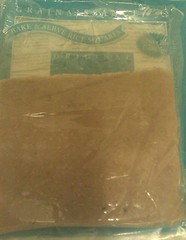
Mochi from Whole Foods - nutrition information and preparation (click to enlarge the images). This is quite tasty actually. I have tried the flavored variety and the regular one, and the regular version actually tastes better.
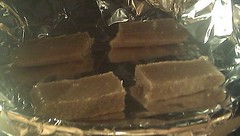
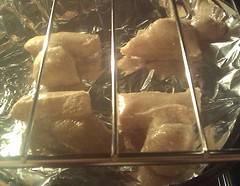
Mochi - before baking (left). Baked mochi (right) (click to enlarge the images).
Mochi - before baking (left). Baked mochi (right) (click to enlarge the images).
Related reading:
Mochi. Wikipedia.
Akashi Kaikyō Bridge - 100 Wonders of the World
This series of blog posts is based on the book 100 Wonders of the World by Michael Hoffman and Alexander Krings.
The Akashi-Kaikyō Bridge is the largest bridge in the world.
The Akashi-Kaikyō Bridge, also known as the Pearl Bridge, has the longest central span of any suspension bridge, at 1,991 metres (6,532 ft). It is located in Japan and was completed in 1998. The bridge links the city of Kobe on the mainland of Honshū to Iwaya on Awaji Island by crossing the busy Akashi Strait. It carries part of the Honshū-Shikoku Highway.
Before the Akashi Kaikyō Bridge was built, ferries carried passengers across the Akashi Strait in Japan. This dangerous waterway often experiences severe storms, and in 1955, two ferries sank in the strait during a storm, killing 168 people. The ensuing shock and public outrage convinced the Japanese government to develop plans for a suspension bridge to cross the strait.
The Akashi Strait is an international waterway that necessitated the provision of a 1,500-metre (4,921 ft)-wide shipping lane.
The bridge was designed to withstand winds of 286 kilometres per hour (178 mph), earthquakes measuring to 8.5 on the Richter scale, and harsh sea currents. The region is tectonically extremely active, with smaller earthquakes occurring almost daily.
Each of the major steel cables is 3 feet thick, 13,000 feet long and is composed of 290 bundles of wire.
The bridge is used by approximately 23,000 cars/day.
View Larger Map
References:
Akashi Kaikyō Bridge. Wikipedia, public domain.
The Akashi-Kaikyō Bridge is the largest bridge in the world.
The Akashi-Kaikyō Bridge, also known as the Pearl Bridge, has the longest central span of any suspension bridge, at 1,991 metres (6,532 ft). It is located in Japan and was completed in 1998. The bridge links the city of Kobe on the mainland of Honshū to Iwaya on Awaji Island by crossing the busy Akashi Strait. It carries part of the Honshū-Shikoku Highway.
Before the Akashi Kaikyō Bridge was built, ferries carried passengers across the Akashi Strait in Japan. This dangerous waterway often experiences severe storms, and in 1955, two ferries sank in the strait during a storm, killing 168 people. The ensuing shock and public outrage convinced the Japanese government to develop plans for a suspension bridge to cross the strait.
The Akashi Strait is an international waterway that necessitated the provision of a 1,500-metre (4,921 ft)-wide shipping lane.
The bridge was designed to withstand winds of 286 kilometres per hour (178 mph), earthquakes measuring to 8.5 on the Richter scale, and harsh sea currents. The region is tectonically extremely active, with smaller earthquakes occurring almost daily.
Each of the major steel cables is 3 feet thick, 13,000 feet long and is composed of 290 bundles of wire.
The bridge is used by approximately 23,000 cars/day.
View Larger Map
References:
Akashi Kaikyō Bridge. Wikipedia, public domain.
Sumo wrestlers have a life expectancy of under 60 years
From USA Today:
Sumos wrestlers have a life expectancy of under 60 years. "Men live well into their 80s in Japan, so there's little doubt that carrying around a lot of extra weight is stressful."
"The key point in Sumo is staying fit," says Akebono, the first American-born sumo to earn the rank of yokozuna, sumo's penultimate level. "We have no off-season and train six or seven days a week."
But retired sumos and regular Americans exercise less with each passing decade. At the same time, their metabolism slows. And like Konishiki and Akebono, their ability to exercise is often limited by arthritis and longstanding injuries.
Kotooshu vs. Kakizoe 2006 Kyushu Basyo Day 7.
Asashoryu vs. Kotooshu.
References:
Sumos wrestle with retirement health challenges. USA Today, 2001.
Sumos wrestlers have a life expectancy of under 60 years. "Men live well into their 80s in Japan, so there's little doubt that carrying around a lot of extra weight is stressful."
"The key point in Sumo is staying fit," says Akebono, the first American-born sumo to earn the rank of yokozuna, sumo's penultimate level. "We have no off-season and train six or seven days a week."
But retired sumos and regular Americans exercise less with each passing decade. At the same time, their metabolism slows. And like Konishiki and Akebono, their ability to exercise is often limited by arthritis and longstanding injuries.
Kotooshu vs. Kakizoe 2006 Kyushu Basyo Day 7.
Asashoryu vs. Kotooshu.
References:
Sumos wrestle with retirement health challenges. USA Today, 2001.
Subscribe to:
Posts (Atom)
