This is a no-knead bread. It relies on slow, low-temperature fermentation in the refrigeration overnight to do the kneading for you. The dough can be kept in a container in the fridge for up to 3 weeks. You can use portions of the dough as needed during that time period of 3 weeks.
Ingredients
1. Active dry yeast
2. Salt
3. Flour
4. Large, resealable container (large water pitcher would do) and a measuring cup
5. Warm water and a spoon
How to make it
1. Take 3 cups of warm water and pour it into the container. Stir in 1.5 tablespoons of salt (I use much less salt, approximately 1/4 teaspoon). Add 1.5 tablespoons of dry yeast and stir. Let the mixture sit for 2-3 minutes, until the yeast fully dissolves and starts bubbling.
2. Add approximately 6 cups of flour. Stir the mixture together with a spoon until a loose sticky dough forms. This the most time consuming step of the process and it takes about 3-5 minutes.
3. When there are no more pockets of unmixed flour or water left, place the lid loosely on top of the container, and let the dough sit at room temperature until it rises. It typically takes 1-2 hours.
4. When the dough has risen to the top, punch it down slightly to fit the lid onto the container. Seal it and place the container in the fridge for a few hours, or overnight. You can keep the dough in the fridge for up to 3 weeks.
5. Take a loaf pan or whatever you want to bake on, and preheat your oven to 450 Fahrenheit (230 Celsius). Grease the pan with oil. While your hands are still oily, pick off a part of the dough. Form it into a loaf and slash the top. Bake the loaf for 30-35 minutes at 450 Fahrenheit (230 Celsius). You can increase the temperature up to 500 Fahrenheit (260 Celsius) for the last 5-10 minutes to improve the crust.
Mnemonic - remember the rule of 3's:
- 3 cups of water
- 1.5 tablespoons of dry yeast
- 1.5 tablespoons of salt
- 3+3 (6) cups of flour
- 30 minute baking time
- 3 week storage in the fridge
I have achieved the best results with the regular Ultragrain unbleached flour from Coscto and their Red Star yeast:
No-Knead Bread Recipe from Bob's Red Mill
References:
How to Make Easy, Fast, Foolproof Bread from Scratch http://bit.ly/UvJQsv
Pane Rustico, White Flour - Italian "Peasant" Bread - David B. Fankhauser, Ph.D. http://buff.ly/Yb4bJO
Traditional Greek bread - YouTube http://buff.ly/YcSVwx
Хляб без месене « нож и виличка http://bit.ly/YjR5FF
I tried this rye flour from Amazon but the bread was too "chewy": Bob's Red Mill Organic Rye Flour Dark, 22-Ounce (Pack of 4):
This rye flour, in a much larger package, may be a better deal: Great River Organic Milling, Organic Specialty Rye Flour, 25-Pound Package:
I am planning to try this barley flour from Amazon: Bob's Red Mill Barley Flour, 20-Ounce (Pack of 4)
Showing posts with label Recipes. Show all posts
Showing posts with label Recipes. Show all posts

"Bob Chorba"- traditional bean soup - Bulgarian recipe
Ingredients
200 g to 455 g (1 lb) white beans (Great Northern beans are a suitable variety in the U.S.)
2-3 carrots
1/2 celery
1-2 onion
1-2 tomatoes
1-2 bell peppers
1-2 chilies
Optional — parsley, mint (or oregano, 1 tsp), sunflower oil (or olive oil, 2 tbsp), salt to taste
2 qt. water
Preparation
Soak the beans in cold water overnight. Next morning drain off the water, add the same amount of fresh water and bring to boil. Boil in an earthenware pot (or regular pot) together with the oil, finely chopped carrots, onion and celery.
Simmer gently for 1-2 hours or until the beans soften.
The sliced peppers are added later; the grated tomatoes and mint, when the beans have turned tender. Salt and boil for another 15-20 minutes.
Serve sprinkled with finely chopped parsley.
Here is my modified recipe for "Bob Chorba" (it takes 1 hour from start to finish):
Ingredients
- 200 g to 455 g (1 lb) of Anasazi beans (it depends on the desired amount)
- 1-2 onion
- 1-2 tomatoes
- 1-2 peppers
- red pepper (ground)
- parsley, olive oil (2 tbsp), salt to taste
- 2 qt. water
Preparation
Bring the beans to a boil. Replace the water after the first boil, and bring the beans to boil again. Simmer gently for 1 hour total, or until the beans soften.
Bean soup cooking takes only one hour - here is what I do
I use Anasazi beans because the soup ("bob chorba") with them is ready in just 60 minutes. Here is the breakdown in 3 easy steps. I bring the beans to a boil which takes about 3-5 minutes, and then replace the water after the first boil. I bring the beans to boil again. During that time, I cut the onion, tomatoes, pepper and parsley.
See how to add the ingredients below in 3 steps. Each step takes 20 minutes and you can use a timer set at 20 minutes to simplify the process:
1. Boil at low heat for 20 minutes. After that, add the oil, finely chopped onion, pepper, salt.
2. Simmer for 20 minutes. After that, add the tomatoes and the ground red pepper.
3. Simmer for 20 minutes. After that, add the parsley at very end.
Optional: In a separate plan fry the onions in oil until golden brown, add flour, stir and fry for less then a minute. Add the paprika, stir and add to the beans. Add the tomatoes and oregano as well. Leave the soup to simmer on a low heat for about 20 minutes.
References:
Cuisine of Bulgaria - Wikibooks http://goo.gl/fLpne
Bulgarian Cuisine http://goo.gl/FPYPi
В село Смилян се проведе празник на боба - YouTube http://goo.gl/sK96g
Боб Чoрба - Bean stew - YouTube http://goo.gl/nNhUS
Homemade Pizza Recipes - without the need for 800-plus degree brick oven - WSJ
From the WSJ:
Purists will insist that without a brick oven in your backyard, you'll never achieve the sort of blazing inferno (think: 800-plus degrees) that yields carbon-streaked crusts with a balance of crunch and chew.
However, a WSJ experts suggests a simpler arsenal: let your dough rise overnight for fuller flavor, a pizza stone or two to boost and hold that all-important heat in the oven and a peel—preferably metal (tip: you can use the flat back of a baking sheet in a pinch)—to extract the pie with a minimum of mess when it's ready.
References:
Homemade Pizza Recipes: Pizza Perfect - WSJ http://goo.gl/MLRpE
Fish cooking tips: bake at 450°F for 10 minutes per inch of thickness
Tips from the Whole Foods blog:
- Season fish fillets with marinade or a spice rub and broil or bake at 450°F for about 10 minutes per inch of thickness. Serve with a squeeze of lemon alongside a salad and whole grains.
- Grill seafood steaks or fillets. If over ½” thick, turn the fish halfway through cooking, using the 10-minutes-per-inch rule. Pair grilled seafood with the bright flavor of salsa
- Shrimp and large cubes of firm fish are perfect for kabobs. Place on skewers with quick-cooking fruits or veggies. Serve over wild rice.
- Small or thin fillets are well suited to pan sautéing. Heat a bit of marinade or oil in a heavy skillet and add the fish. Remove when it flakes easily and add some chopped greens or spinach to the pan along with a splash of vinegar or white wine for a quick side to serve with the fish.
- Simmer fillets or steaks in a bit of broth or seasoned liquid (try a blend of orange juice, soy sauce, ginger and garlic) and cook while covered.
- Shrimp, scallops and diced fish fillets contribute depth of flavor to broths and soups. Add seafood toward the end of cooking.
References:
Simple Ways to Enjoy Seafood
Penne arrabbiata (“angry pasta”) - penne with tomato and red pepper
From YellowSaffron YouTube channel:
Penne arrabbiata is a famous classic Italian recipe, a spicy hot pasta dish, easy and quick to prepare. The penne arrabbiata is part of the Roman culinary tradition, it's a simple speciality with a strong and spicy taste.
Boil the ridged pasta quills in a pot with plenty of water (add some salt); in the meanwhile scald the tomatoes in order to peel them easily (otherwise you can use canned peeled tomatoes); then chop the tomatoes in small pieces removing the seeds.
Brown the chopped garlic and the chili peppers with the oil (1), add the tomatoes (2) and cook the sauce for 5 minutes (3), then add salt to taste.
Sauté the pasta quills with the sauce, then put them in a serving dish and garnish with grated pecorino cheese and fresh chopped parsley.
Frozen Penne Arrabiata is available at Trader Joe's and the little bag can deliver a "restaurant quality" Italian meal in 9 minutes. It is easy to prepare, just heat 2 tablespoons of olive oil or water in the skillet, add the contents of the bag, and stir occasionally.
References:
Penne with Tomato and Red Pepper. Anna Maria Volpi.
Quinoa with dried cherries and milk

1% Organic milk from Costco

Dried Cherries from Costco

Quinoa with dried cherries and milk
Related:
Quinoa’s Global Success Creates Quandary in Bolivia - NYTimes, 2011.
Get to Know: Quinoa | Whole Foods Market http://buff.ly/1psdXRL
Get to Know: Quinoa | Whole Foods Market http://buff.ly/1psdXRL
Recipe: How to Make Bagels With a Breadmaker Machine
Recipe for homemade bagels:
Prep Time: 2 hours
Cook Time: 35 minutes
Total Time: 2 hours, 35 minutes
Ingredients:
1 cup water
1 teaspoon salt
1-1/2 teaspoon sugar (some recipes use 1/2 spoons of sugar)
3 cups bread flour
1 teaspoon active dry yeast (some recipes use 2 1/4 spoons of yeast)
Egg yolk
Optional toppings: seeds, onions, garlic chips or cheddar cheese
This is the recipe from the video:
1/3 Cup Water
1/4 Cup Oil
2 Eggs
3 Cups Bread Flour
1 1/2 Teaspoon instant yeast
1 Tablespoon Sugar
1/2 Teaspoon Salt
References:
Bagels. About.com Guide.
Bread Machine Bagels. AllRecipes.com.
How to grill-roast peppers
From Chicago Tribune:
1. Prepare a charcoal grill or heat a gas grill to medium-high heat. Wipe the peppers clean. Rub lightly with olive oil. Place on the grill directly over heat source. Cover grill. Cook 5 minutes, turn and continue grilling and turning until peppers are evenly blackened and blistered, about 15 minutes total. Remove to a platter and let cool.
2. Gently peel off the charred skin and discard it. Use your hands to pull the stem and seeds out, then tear the peppers into large sections (they'll pull apart naturally at their creases.) Refrigerate covered for up to a couple of days.
Note: Peppers also can be roasted under the broiler: Put the oiled peppers on a baking sheet positioned 6 inches from the broiler's heat source, turning often, until skin is blistered.
References:
Peppers in the hand. Chicago Tribune, 2010.
Video: How To Make Yogurt
How To Make Yogurt
Related:
How to Tend to Your Inner Garden – Your Gut Flora: Do you eat a variety of cultured foods? natto, kimchi, kefir, pickles, yogurt, sauerkraut, rakfisk, poi, kombucha http://buff.ly/1D8f1T1
Video: How To Make Grilled Pork Chops
Video: How To Make Grilled Pork Chops.
How To Make Grilled Pork Tenderloin.
Video: How To Use a Pizza Stone
Howcast | July 09, 2010 | A pizza stone can help distribute heat evenly across the pizza base and make the pizza's dough crispy.
Spaghetti alla Carbonara Recipe - Pasta Carbonara
Learn how to make Spaghetti alla Carbonara Recipe.
Recipe: Baked beans and fish
Ingredients
1. One can of brown beans, law-salt, from Whole Foods.
2. Cod fish, boneless and skinless, 2 pieces.
3. Six cherry tomatoes.
Instructions
1. Place the beans, fish and chopped tomatoes together, add olive oil and red pepper.
2. Bake at 450 F.
Related reading:
Learn to Cook: White Beans. Whole Foods blog, 2012.
Bread from Bread machine (Breadmaker)
From Wikipedia:
A bread machine or breadmaker is a home appliance for baking bread. It consists of a bread pan (or "tin") with a paddle mounted in the center, in a small special-purpose oven, with a control panel. While most bread machines have different cycles for different kinds of dough (including straight white bread, whole grain, European-style (sometimes labelled "French"), and dough-only (for pizza dough and shaped loaves baked in the oven), many also have a timer to allow the bread machine to activate without operator attendance.
The first breadmaker was released in Japan in 1986 by the Matsushita Electric Industrial Co. (now Panasonic). A decade later they had become popular in the United Kingdom, Australia and the United States. While not viable for commercial use due to the fixed loaf shape and the limited duty cycle, bread machines often produce the best results when dealing with kneaded doughs.
To create a loaf of bread, ingredients are measured into the bread pan in a specified order (usually liquids first, with solid ingredients layered on top) and the pan is then placed in the breadmaker. The order of ingredients is important because the instant yeast used in breadmakers is activated by contact with water, so the yeast and the water must be kept apart until the program starts.

The machine takes a few hours to make a loaf of bread, first by turning the ingredients into dough using the paddle, proofing the loaf utilizing ideal temperature control, then baking the loaf. Once the bread has been baked, the pan is extracted from the breadmaker and the bread freed from the pan. The paddle, now at the bottom of the loaf, is removed, leaving a small paddle-shaped indentation or hole. The shape of the finished loaf is often considered unusual, with many early bread machines producing a vertically-oriented, square or cylindrical loaf very different from commercial breads; however, more recent units generally have a more traditional-appearing horizontal pan.
Bread machine recipes are often somewhat smaller than standard bread recipes, and are sometimes standardized based on the capacity of the machine's pan; most common in the United States market are 1.5lb/700g units, and the majority of recipes are written for that capacity; however, 2lb/900g units are not uncommon as well. Packaged bread mixes are available, specifically designed for breadmakers, containing premeasured ingredients including flour and yeast, as well as flavorings and occasionally dough conditioners. Only water usually needs to be added. Bread machines generally do not deal well with non-wheat flours, so any recipe that requires a substantial addition of a grain such as rye or corn that lacks gluten will prove difficult at best in a bread machine, as will any dough with unusually large amounts of liquid (such as ciabatta).
Bread machine. Wikipedia.
A bread machine or breadmaker is a home appliance for baking bread. It consists of a bread pan (or "tin") with a paddle mounted in the center, in a small special-purpose oven, with a control panel. While most bread machines have different cycles for different kinds of dough (including straight white bread, whole grain, European-style (sometimes labelled "French"), and dough-only (for pizza dough and shaped loaves baked in the oven), many also have a timer to allow the bread machine to activate without operator attendance.
The first breadmaker was released in Japan in 1986 by the Matsushita Electric Industrial Co. (now Panasonic). A decade later they had become popular in the United Kingdom, Australia and the United States. While not viable for commercial use due to the fixed loaf shape and the limited duty cycle, bread machines often produce the best results when dealing with kneaded doughs.
To create a loaf of bread, ingredients are measured into the bread pan in a specified order (usually liquids first, with solid ingredients layered on top) and the pan is then placed in the breadmaker. The order of ingredients is important because the instant yeast used in breadmakers is activated by contact with water, so the yeast and the water must be kept apart until the program starts.
The machine takes a few hours to make a loaf of bread, first by turning the ingredients into dough using the paddle, proofing the loaf utilizing ideal temperature control, then baking the loaf. Once the bread has been baked, the pan is extracted from the breadmaker and the bread freed from the pan. The paddle, now at the bottom of the loaf, is removed, leaving a small paddle-shaped indentation or hole. The shape of the finished loaf is often considered unusual, with many early bread machines producing a vertically-oriented, square or cylindrical loaf very different from commercial breads; however, more recent units generally have a more traditional-appearing horizontal pan.
Bread machine recipes are often somewhat smaller than standard bread recipes, and are sometimes standardized based on the capacity of the machine's pan; most common in the United States market are 1.5lb/700g units, and the majority of recipes are written for that capacity; however, 2lb/900g units are not uncommon as well. Packaged bread mixes are available, specifically designed for breadmakers, containing premeasured ingredients including flour and yeast, as well as flavorings and occasionally dough conditioners. Only water usually needs to be added. Bread machines generally do not deal well with non-wheat flours, so any recipe that requires a substantial addition of a grain such as rye or corn that lacks gluten will prove difficult at best in a bread machine, as will any dough with unusually large amounts of liquid (such as ciabatta).
How to make bread with a breadmaker machine - this recipe applies to the following model: Sunbeam 5891 2-Pound Programmable Breadmaker
Take a measuring cup. Pour water in the cup to the measure of "1 cup and 2 grades". Pour the water in the breadmaker container, add olive oil - approximately 1 tablespoon.
Dry the measuring cup with a cloth. Add "3 and 1/3 grades" of flour to the measure cup. Add a little of flaxseed flour.
Pour the flour from the measuring cup to the metal container of the breadmaker. Put the container in the breadmaker machine.
Make a central indentation in the flour in the metal cup. Add 1/2 teaspoon of salt in the indentation. Add 1 and 1/2 teaspoon of yeast in the indentation.
Press "start". Remove the cup after the beeping signal (after approximately 3 hours).
References:Bread machine. Wikipedia.
Related reading:
Lentil soup
From Wikipedia:
The lentil or Masoor (Lens culinaris), considered a type of pulse, is a annual plant (bush) of the legume family, grown for its lens-shaped seeds. It is about 15 inches (38 cm) tall and the seeds grow in pods.
The plant likely originated in the Near East, and has been part of the human diet since the aceramic (non-pottery producing) Neolithic times, being one of the first crops domesticated in the Near East. With approximately 26% of their calories from protein, lentils and generally any pulses or legumes have the third-highest level of protein, by weight, of any plant-based food after soybeans and hemp.
A variety of pulses or lentils exists with colors that range from yellow to red-orange to green, brown and black.

The seeds have a short cooking time (especially for small varieties with the husk removed, such as the common red lentil) and a distinctive earthy flavor. Lentils are used throughout India, the Mediterranean regions and the Middle East. They are frequently combined with rice, which has a similar cooking time. A lentil and rice dish is referred to in the Middle East as mujaddara or mejadra. Rice and lentils are also cooked together in khichdi, a popular Indian dish; a similar dish, kushari, is made in Egypt and considered one of two national dishes. Lentils are used to prepare an inexpensive and nutritious soup all over Europe and North and South America, sometimes combined with some form of chicken or pork.
A large percentage of Indians are vegetarian, and lentils have long been part of the indigenous diet as a common source of protein. Lentils are deficient in two essential amino acids, methionine and cystine.
Health magazines have selected lentils as one of the five healthiest foods.
"Lentils, a small but nutritionally mighty member of the legume family, are a very good source of cholesterol-lowering fiber. Not only do lentils help lower cholesterol, they are of special benefit in managing blood-sugar disorders since their high fiber content prevents blood sugar levels from rising rapidly after a meal. Just 230 calories for a whole cup of cooked lentils. This tiny nutritional giant fills you up--not out."
Lentils are one of the best vegetable sources of iron. This makes them an important part of a vegetarian diet, and useful for preventing iron deficiency.
Lentils are relatively tolerant to drought and are grown throughout the world. About a third of the worldwide production of lentils is from India, most of which is consumed in the domestic market. Canada is the largest export producer of lentils in the world and Saskatchewan is the most important producing region in Canada. The Palouse Region of Eastern Washington and the Idaho Panhandle, with its commercial center at Pullman, WA, constitutes the most important producing region in the United States.
FAO reports that world production of lentils is primarily coming from India (36%), Canada (17%) and Turkey (15%). National Agricultural Statistics Service (NASS) reports United States production is primarily coming from North Dakota, Montana, Washington, and Idaho.
Lentils are mentioned many times in the Old Testament, the first time recounting the incident in which Jacob purchases the birthright from Esau with stewed lentils (a "mess of pottage") {Genesis 25:34}. In Jewish mourning tradition, they are considered as food for mourners, together with boiled eggs. The reason is that their round shape symbolizes the life cycle from birth to death.
In Italy eating lentils on New Year's Eve traditionally symbolizes the wish to earn more money next year, most likely because of their round coin-like shape.
References:
Lentil. Wikipedia.
The lentil or Masoor (Lens culinaris), considered a type of pulse, is a annual plant (bush) of the legume family, grown for its lens-shaped seeds. It is about 15 inches (38 cm) tall and the seeds grow in pods.
The plant likely originated in the Near East, and has been part of the human diet since the aceramic (non-pottery producing) Neolithic times, being one of the first crops domesticated in the Near East. With approximately 26% of their calories from protein, lentils and generally any pulses or legumes have the third-highest level of protein, by weight, of any plant-based food after soybeans and hemp.
A variety of pulses or lentils exists with colors that range from yellow to red-orange to green, brown and black.
The seeds have a short cooking time (especially for small varieties with the husk removed, such as the common red lentil) and a distinctive earthy flavor. Lentils are used throughout India, the Mediterranean regions and the Middle East. They are frequently combined with rice, which has a similar cooking time. A lentil and rice dish is referred to in the Middle East as mujaddara or mejadra. Rice and lentils are also cooked together in khichdi, a popular Indian dish; a similar dish, kushari, is made in Egypt and considered one of two national dishes. Lentils are used to prepare an inexpensive and nutritious soup all over Europe and North and South America, sometimes combined with some form of chicken or pork.
A large percentage of Indians are vegetarian, and lentils have long been part of the indigenous diet as a common source of protein. Lentils are deficient in two essential amino acids, methionine and cystine.
Health magazines have selected lentils as one of the five healthiest foods.
"Lentils, a small but nutritionally mighty member of the legume family, are a very good source of cholesterol-lowering fiber. Not only do lentils help lower cholesterol, they are of special benefit in managing blood-sugar disorders since their high fiber content prevents blood sugar levels from rising rapidly after a meal. Just 230 calories for a whole cup of cooked lentils. This tiny nutritional giant fills you up--not out."
Lentils are one of the best vegetable sources of iron. This makes them an important part of a vegetarian diet, and useful for preventing iron deficiency.
Lentils are relatively tolerant to drought and are grown throughout the world. About a third of the worldwide production of lentils is from India, most of which is consumed in the domestic market. Canada is the largest export producer of lentils in the world and Saskatchewan is the most important producing region in Canada. The Palouse Region of Eastern Washington and the Idaho Panhandle, with its commercial center at Pullman, WA, constitutes the most important producing region in the United States.
FAO reports that world production of lentils is primarily coming from India (36%), Canada (17%) and Turkey (15%). National Agricultural Statistics Service (NASS) reports United States production is primarily coming from North Dakota, Montana, Washington, and Idaho.
Lentils are mentioned many times in the Old Testament, the first time recounting the incident in which Jacob purchases the birthright from Esau with stewed lentils (a "mess of pottage") {Genesis 25:34}. In Jewish mourning tradition, they are considered as food for mourners, together with boiled eggs. The reason is that their round shape symbolizes the life cycle from birth to death.
In Italy eating lentils on New Year's Eve traditionally symbolizes the wish to earn more money next year, most likely because of their round coin-like shape.
References:
Lentil. Wikipedia.
How to Make Houmous - BBC Video
BBCWorldwide — May 20, 2010 — Delia Smith once again delves in the freezer to serve up one of her own favourite recipes, houmous served with pitta bread. Clip taken from her series of handy recipe shortcuts using ready-made ingredients.
Strudel
From Wikipedia:
A strudel is a type of layered pastry with a sweet filling inside. It became well known and gained popularity in the 18th century through the Habsburg Empire. Strudel is most often associated with Austrian cuisine, but is also a traditional pastry in the whole area formerly belonging to the Austro-Hungarian empire.
The oldest Strudel recipe is from 1696, a handwritten recipe at the Viennese City Library, Wiener Stadtbibliothek. The pastry has its origins in the similar Byzantine Empire or Middle Eastern pastries (see baklava and Turkish cuisine).

Strudel is a loanword in English from German.The word itself derives from the German word Strudel, which in Middle High German literally means "whirlpool" or "eddy".
In Hungary it is known as rétes, in Slovenia as štrudelj or zavitek.
The best-known kinds of Strudel are Apfelstrudel (German for strudel with apple) and Topfenstrudel (with sweet soft quark cheese, in German Topfen cheese).
Traditional Austrian Strudel pastry is different from strudels served in other parts of the world that are often made from filo or puff pastry. The traditional Strudel pastry dough is very elastic. It is made from flour with a high gluten content, egg, water and butter with no sugar added. The dough is worked vigorously, rested and then rolled out and stretched by hand very thinly.
Pertaining to anecdotes, purists say, it should be so thin that a newspaper can be read through it. A legend has it that the Austrian Emperor's perfectionist cook decreed that it should be possible to read a love letter through it. The thin dough is laid out on a tea towel and the filling is spread on it. The dough with the filling on top is rolled up carefully with the help of the towel and baked in the oven.
Strudel had been part of Israeli cuisine since the arrival of numerous immigrants from Central Europe in the 1920s and 1930s. Since the introduction of email, the at sign (@) became known as "strudel" in colloquial Hebrew.
References:
Strudel. Wikipedia.
A strudel is a type of layered pastry with a sweet filling inside. It became well known and gained popularity in the 18th century through the Habsburg Empire. Strudel is most often associated with Austrian cuisine, but is also a traditional pastry in the whole area formerly belonging to the Austro-Hungarian empire.
The oldest Strudel recipe is from 1696, a handwritten recipe at the Viennese City Library, Wiener Stadtbibliothek. The pastry has its origins in the similar Byzantine Empire or Middle Eastern pastries (see baklava and Turkish cuisine).
Strudel is a loanword in English from German.The word itself derives from the German word Strudel, which in Middle High German literally means "whirlpool" or "eddy".
In Hungary it is known as rétes, in Slovenia as štrudelj or zavitek.
The best-known kinds of Strudel are Apfelstrudel (German for strudel with apple) and Topfenstrudel (with sweet soft quark cheese, in German Topfen cheese).
Traditional Austrian Strudel pastry is different from strudels served in other parts of the world that are often made from filo or puff pastry. The traditional Strudel pastry dough is very elastic. It is made from flour with a high gluten content, egg, water and butter with no sugar added. The dough is worked vigorously, rested and then rolled out and stretched by hand very thinly.
Pertaining to anecdotes, purists say, it should be so thin that a newspaper can be read through it. A legend has it that the Austrian Emperor's perfectionist cook decreed that it should be possible to read a love letter through it. The thin dough is laid out on a tea towel and the filling is spread on it. The dough with the filling on top is rolled up carefully with the help of the towel and baked in the oven.
Strudel had been part of Israeli cuisine since the arrival of numerous immigrants from Central Europe in the 1920s and 1930s. Since the introduction of email, the at sign (@) became known as "strudel" in colloquial Hebrew.
References:
Strudel. Wikipedia.
Banitsa
From Wikipedia:
Banitsa (Bulgarian: Баница, also transliterated as banica and banitza) is a traditional Bulgarian pastry prepared by layering a mixture of whisked eggs and pieces of cheese (sirene) between filo pastry and then baking it in an oven.
Traditionally, lucky charms are put into the pastry on certain occasions, particularly on Christmas Eve, the first day of Christmas, or New Year's Eve. These charms may be coins or small symbolic objects (e.g., a small piece of a dogwood branch with a bud, symbolizing health or longevity). More recently, people have started writing happy wishes on small pieces of paper and wrapping them in tin foil. Wishes may include happiness, health, or success throughout the new year.
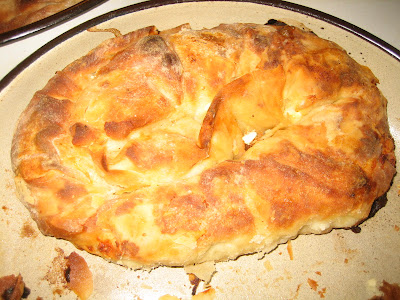
Banitsa is served for breakfast with plain yogurt, ayran, or boza. It can be eaten hot or cold. Some varieties include banitsa with spinach (spanachena banitsa) or the sweet version, banitsa with milk (mlechna banitsa) or pumpkin (tikvenik).
Traditionally, banitsa is made with homemade or commercially made pastry sheets that are prepared from a baker's hard dough including flour, eggs, and water. At home the sheets can be spread by continuously pulling the sheet of dough with one's fingers until it becomes less than a millimeter thin, or by using a rolling-pin in several stages with vegetable oil sprinkled between the partially spread leaves, or by a very difficult technique comprising waving movements of the entire sheet over the head of the cook, which resembles pizza dough making techniques.
Another sort of banitsa is called tutmanik (тутманик) and is made with leavened sheets. The usual filling is cheese.
The traditional filling is made of crushed white or feta cheese, yoghurt, and eggs. Sometimes baking soda is added to the yogurt, which makes the yogurt rise (as the baking soda reacts with the acid in yogurt). The addition of baking soda results in a fluffier filling.
Vegetable fillings include spinach, nettles, leeks, onions, or sauerkraut. The cabbage variant is called zelnik (зелник) and the leek variant is called luchnik (лучник). There are also meat fillings with minced meat, onions, and mushrooms.
Sweet fillings with apples (similar to apple pie or strudel) or pumpkin with sugar, walnuts and cinnamon exist as well. In some regions, only the walnuts, sugar, and cinnamon are used. The apple variant is called shtrudel (щрудел), and the pumpkin variant is tikvenik (тиквеник).
Preparation
In a large greased baking dish, individual sheets are layered one by one with small amounts of filling and vegetable oil between them. After half of the sheets are placed in the pan, a large portion of the filling is spooned onto the leaves and is then covered with the remaining sheets and filling in the same manner. The pastry is then baked at 200-250 degrees Celsius.
An alternative method of preparation is taking each sheet of dough, laying it out flat and sprinkling some of the filling on it. Then, the sheet is rolled up into a tight roll with the filling on the inside of the roll. The long roll is then taken and rolled up in a circle. This first sheet of dough is then placed in the baking pan. The process is repeated with the remaining sheets of dough and each consecutive roll is placed around the first one in the pan. The resulting shape resembles a spiral (see photo). The banitsa is then sprinkled with vegetable oil and baked.
Symbolism
In Bulgaria, banitsa is a symbol of Bulgarian cuisine and traditions. Traditionally, Bulgarians prepare and serve banitza on two holidays - Christmas and New Year's Eve. On these days, people add kismets (fortunes, lucky charms) into the banitsa. The lucky charms are usually small pieces of dogwood branch, which vary in numbers of buds on them. They symbolize health and longevity. The branches are hidden inside the banitsa, and the banitsa is then baked. When ready, the banitsa is cut in a way that each piece contains a dogwood branch. A wish is associated with each branch and the different number of buds on the branch helps to recognize the corresponding wish. The wishes include happiness, health, success, travel, etc. The banitsa is then spun on the table and everyone takes the piece which is in front of them when the spinning stops. Then they find their fortune inside the piece - the fortunes predict what one is to expect from the new year. The most common fortunes are "wealth", "health", "love", "marriage", "baby", "journey", etc.
Alternatively or in addition to the kismets, some add a coin or simply little pieces of paper with written fortunes on them (just like the ones in the fortune cookies). In this case, they are wrapped in tin foil to preserve them during baking.
The word "banitsa" is used as a simile for something (mainly documents and paperwork) crumpled, or badly maintained. For example, a police officer can make a remark to someone about letting his or her passport "become like a banitsa" (станал е на баница); a teacher might say this about a pupil's notebook.
References:
Banitsa. Wikipedia.
Cuisine of Bulgaria - Wikibooks http://goo.gl/fLpne
Bulgarian Cuisine http://goo.gl/FPYPi
Banitsa (Bulgarian: Баница, also transliterated as banica and banitza) is a traditional Bulgarian pastry prepared by layering a mixture of whisked eggs and pieces of cheese (sirene) between filo pastry and then baking it in an oven.
Traditionally, lucky charms are put into the pastry on certain occasions, particularly on Christmas Eve, the first day of Christmas, or New Year's Eve. These charms may be coins or small symbolic objects (e.g., a small piece of a dogwood branch with a bud, symbolizing health or longevity). More recently, people have started writing happy wishes on small pieces of paper and wrapping them in tin foil. Wishes may include happiness, health, or success throughout the new year.
Banitsa is served for breakfast with plain yogurt, ayran, or boza. It can be eaten hot or cold. Some varieties include banitsa with spinach (spanachena banitsa) or the sweet version, banitsa with milk (mlechna banitsa) or pumpkin (tikvenik).
Traditionally, banitsa is made with homemade or commercially made pastry sheets that are prepared from a baker's hard dough including flour, eggs, and water. At home the sheets can be spread by continuously pulling the sheet of dough with one's fingers until it becomes less than a millimeter thin, or by using a rolling-pin in several stages with vegetable oil sprinkled between the partially spread leaves, or by a very difficult technique comprising waving movements of the entire sheet over the head of the cook, which resembles pizza dough making techniques.
Another sort of banitsa is called tutmanik (тутманик) and is made with leavened sheets. The usual filling is cheese.
The traditional filling is made of crushed white or feta cheese, yoghurt, and eggs. Sometimes baking soda is added to the yogurt, which makes the yogurt rise (as the baking soda reacts with the acid in yogurt). The addition of baking soda results in a fluffier filling.
Vegetable fillings include spinach, nettles, leeks, onions, or sauerkraut. The cabbage variant is called zelnik (зелник) and the leek variant is called luchnik (лучник). There are also meat fillings with minced meat, onions, and mushrooms.
Sweet fillings with apples (similar to apple pie or strudel) or pumpkin with sugar, walnuts and cinnamon exist as well. In some regions, only the walnuts, sugar, and cinnamon are used. The apple variant is called shtrudel (щрудел), and the pumpkin variant is tikvenik (тиквеник).
Preparation
In a large greased baking dish, individual sheets are layered one by one with small amounts of filling and vegetable oil between them. After half of the sheets are placed in the pan, a large portion of the filling is spooned onto the leaves and is then covered with the remaining sheets and filling in the same manner. The pastry is then baked at 200-250 degrees Celsius.
An alternative method of preparation is taking each sheet of dough, laying it out flat and sprinkling some of the filling on it. Then, the sheet is rolled up into a tight roll with the filling on the inside of the roll. The long roll is then taken and rolled up in a circle. This first sheet of dough is then placed in the baking pan. The process is repeated with the remaining sheets of dough and each consecutive roll is placed around the first one in the pan. The resulting shape resembles a spiral (see photo). The banitsa is then sprinkled with vegetable oil and baked.
Symbolism
In Bulgaria, banitsa is a symbol of Bulgarian cuisine and traditions. Traditionally, Bulgarians prepare and serve banitza on two holidays - Christmas and New Year's Eve. On these days, people add kismets (fortunes, lucky charms) into the banitsa. The lucky charms are usually small pieces of dogwood branch, which vary in numbers of buds on them. They symbolize health and longevity. The branches are hidden inside the banitsa, and the banitsa is then baked. When ready, the banitsa is cut in a way that each piece contains a dogwood branch. A wish is associated with each branch and the different number of buds on the branch helps to recognize the corresponding wish. The wishes include happiness, health, success, travel, etc. The banitsa is then spun on the table and everyone takes the piece which is in front of them when the spinning stops. Then they find their fortune inside the piece - the fortunes predict what one is to expect from the new year. The most common fortunes are "wealth", "health", "love", "marriage", "baby", "journey", etc.
Alternatively or in addition to the kismets, some add a coin or simply little pieces of paper with written fortunes on them (just like the ones in the fortune cookies). In this case, they are wrapped in tin foil to preserve them during baking.
The word "banitsa" is used as a simile for something (mainly documents and paperwork) crumpled, or badly maintained. For example, a police officer can make a remark to someone about letting his or her passport "become like a banitsa" (станал е на баница); a teacher might say this about a pupil's notebook.
References:
Banitsa. Wikipedia.
Cuisine of Bulgaria - Wikibooks http://goo.gl/fLpne
Bulgarian Cuisine http://goo.gl/FPYPi
Subscribe to:
Posts (Atom)
